Addressing maternal and child health disparities in Kansas
This opinion piece by Health Fund President David Jordan originally appeared in the Fall 2021 issue of Kansas Child magazine.
All Kansans should get to live in communities where good schools, healthy environments, safe homes, quality jobs, and access to health care and high-quality goods and services are the norm.
To achieve that goal in Kansas, we need to address long-standing racial and ethnic disparities in health, poverty rates, and educational attainment. Addressing these inequities is complex, but improving the health and well-being of mothers, infants, and children is a critically important strategy. It is predictive of future public health challenges for families, communities, and the health system.
We need to address long-standing racial and ethnic disparities in health, poverty rates, and educational attainment.
Unfortunately, significant racial disparities exist in maternal and child health. A recent Kaiser Family Foundation brief highlighted:
Black and American Indian and Alaska Native (AIAN) women have higher rates of pregnancy-related death compared to white women.
Black, AIAN, and Native Hawaiian and Other Pacific Islander (NHOPI) women are more likely than white women to have births with risk factors that increase the likelihood of infant mortality and that can have long-term negative consequences for children’s health.
Infants born to Black, AIAN, and NHOPI women have markedly higher mortality rates than those born to white women.
These disparities, in part, reflect increased barriers to health care among people of color. To improve access to health care for people of color in Kansas and to ensure every Kansan has an opportunity for a healthy start in life, we must:
Invest in prenatal care and equity-based birth education.
Improve access to prenatal services for women of color.
Improve access to comprehensive health care by expanding Medicaid eligibility, extending postpartum coverage to 12 months for new mothers, and continuously covering children ages 0-5.
Invest in a culturally competent health care workforce.
Investing in maternal and child health policies can address long-standing inequities in Kansas as well as improve health outcomes, school readiness, and long-term financial earnings.
Advocacy can inform how American Rescue Plan Act (ARPA) dollars transform your community. Learn more in this webinar recorded on Thursday October 14 with experts from Community Catalyst. They presented their toolkit on how advocates can use ARPA funds to spur transformative change and address the unique needs of communities.
Community Catalyst is a leading non-profit national health advocacy organization dedicated to advancing a movement for health equity and justice. They partner with local, state and national advocates to leverage and build power so all people can influence decisions that affect their health.
This opinion piece by Health Fund President David Jordan originally appeared in the Kansas Reflector on Thursday, October 14, 2021.
When Anjali Kansal-Rill gave birth in 2016, things did not go as planned. Anjali had an emergency cesarean section and faced challenges with breastfeeding. One week postpartum, she didn’t feel like herself. Her doctor said she would prescribe medication if Anjali was still feeling “down” at her next appointment, in eight weeks.
Maternal depression, also known as perinatal or postpartum depression, occurs during pregnancy or the 12 months immediately following delivery. It is the most common obstetric complication in the country. Perinatal depression is linked to an increased risk of preterm birth and low birthweight. Postpartum depression can lead to adverse effects for mothers and infants, affecting the course of children’s health and development.
Maternal depression, like maternal mortality, disproportionately impacts women of color. According to the CDC, 2018 postpartum depression rates were higher among non-Hispanic women of color. Addressing these disparities is essential to ensuring mothers and babies have every chance to be healthy.
As a social worker, Anjali was aware of maternal depression. She thought she may have been overreacting, but her condition worsened.
One night her daughter woke up crying.
“I changed her diaper, but she was squirming so much I couldn’t get her back in her swaddle,” she said. “I got so frustrated I started to cry. … I was afraid I would hurt the baby. I yelled at my husband to take over. He brought her to me to nurse, but my breasts were so painful I broke down sobbing. What good was a mother who couldn’t calm or even feed her child? I told him they would be better off without me.”
The next day, Anjali’s husband made an appointment with her doctor, who diagnosed her with postpartum depression and prescribed medication.
Kansas mothers needed screenings
According to the 2018 Kansas Pregnancy Risk Assessment Monitoring System, approximately one in five mothers reported experiencing depression during pregnancy and one in seven mothers exhibited symptoms of postpartum depression. However, 17% reported they did not receive treatment. Most cited cost or that “it seemed too difficult” as barriers.
Anjali obtained treatment. Originally, she was scheduled for evaluation more than 60 days postpartum, which is when 9,000 Kansas mothers are dropped from Medicaid enrollment each year. Many of these mothers had no way to be screened or treated for maternal depression.
The 2018 Kansas PRAMS data showed 98.9% of new mothers reported their newborn had a well-child visit. In 2016, federal guidance allowed states to cover maternal depression screening during the well-child visit.
To take advantage of this option, Kansas needed to adopt a billing policy change. As of 2019, Kansas was one of only 10 states that had not changed its policy.
In 2019, Kansas joined the Pediatrics Supporting Parents Medicaid/CHIP State Implementation Workgroup, a national effort to develop policies that leverage the pediatric well-child visit to improve social and emotional health. The team of early childhood stakeholders and providers, led by the Kansas Department of Health and Environment with support and facilitation provided by the United Methodist Health Ministry Fund, prioritized expanding maternal depression screens to improve maternal and child health.
The team developed recommendations to allow maternal depression screens to be billed as part of the well-child visit. Kansas Medicaid approved the policy, which became effective this year.
According to Mathematica Policy Research, undetected and untreated maternal depression could cost as much as $17,100 per mother-child pair, meaning Kansas will save millions of dollars by identifying and treating maternal depression as a result of this policy.
What about Anjali and the important work ahead?
Anjali said, “I love my daughter more than I ever could have imagined. It scares me to think about where she would be if I hadn’t gotten help.”
Thanks to maternal depression screenings, more Kansas mothers’ depression will be identified. But barriers to treatment remain, including health care coverage and costs.
New federal policy allows states to extend Medicaid coverage to 12 months postpartum. Kansas needs to adopt this policy change to ensure mothers get the treatment they need.
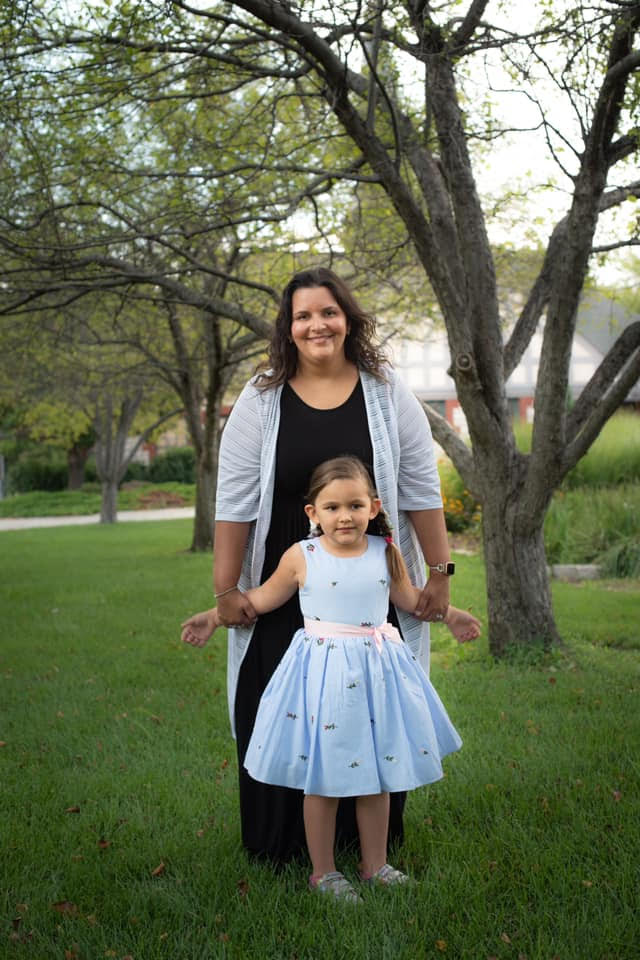
Anjali Kansal-Rill stands with her daughter. (Anjali Kansal-Rill)
Extending coverage would prevent more pregnancy-related deaths — which disproportionately impact Black women in Kansas. It would also ensure mothers and babies have the healthiest start, save the state money by averting future care and decreasing interaction with the child welfare system, and reduce inequities.
Maternal depression screenings are an important baby step in improving the health of families in our state. Let’s take the leap for Kansas mothers and extend postpartum coverage.
Child Care Providers Have Experienced Additional Strain During Pandemic
View the recorded webinar for a discussion of the survey results and the state of child care in Kansas.
Every Kansas child deserves a strong start.
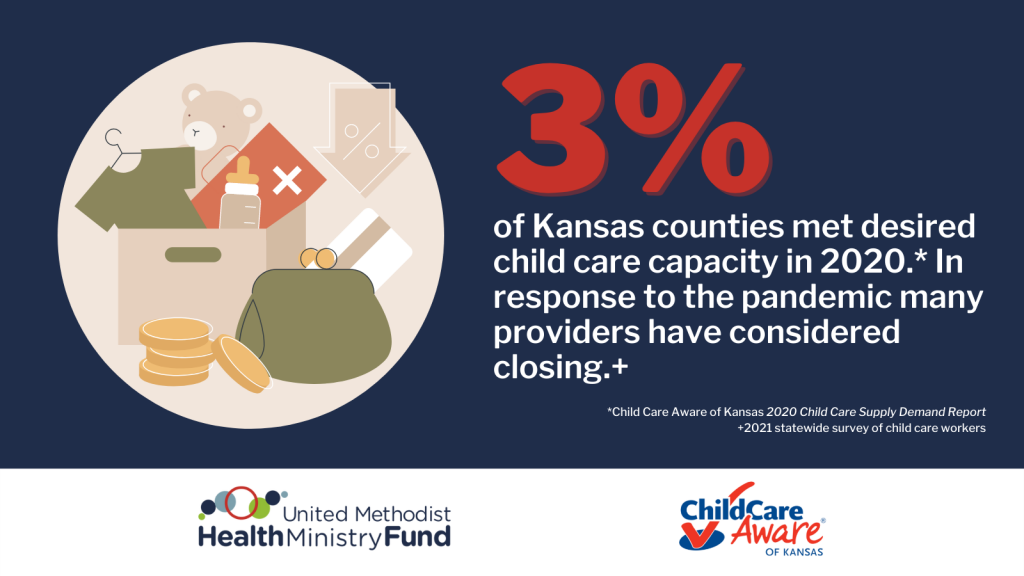
Prior to the pandemic, Kansas child care was in crisis. Child Care Aware of Kansas reported that only three Kansas counties met or exceeded demand—97% of counties did not meet desired capacity. Low-income communities, rural communities, and communities of color faced persistent child care challenges. It’s gotten worse because of the pandemic.
To understand how child care providers have been impacted by the COVID-19 pandemic, Child Care Aware of Kansas and the United Methodist Health Ministry Fund (Health Fund) partnered to survey providers from across the state. The timely survey focused on which precautions were being implemented to prevent the spread of COVID-19 as well as what challenges child care providers have faced throughout the pandemic.
28.9% of licensed providers responded. They represented day care homes, group day care homes, and day care centers, as well as 102 counties (97%).
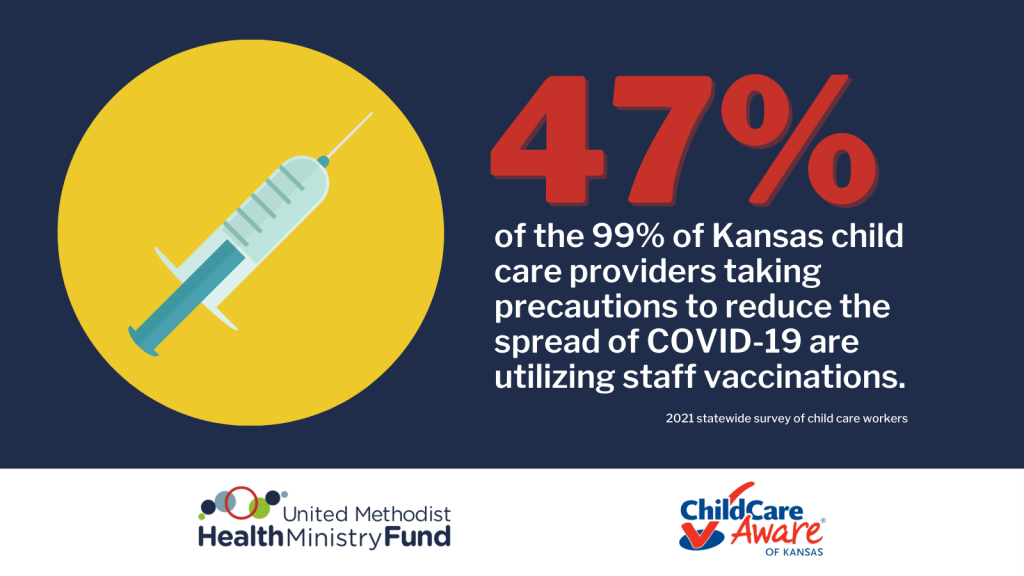
A key finding is that although virtually all Kansas child care providers are taking precautions to reduce the spread of COVID-19, fewer than half are relying on proven public health measures, such as masking, social distancing or vaccinating staff.
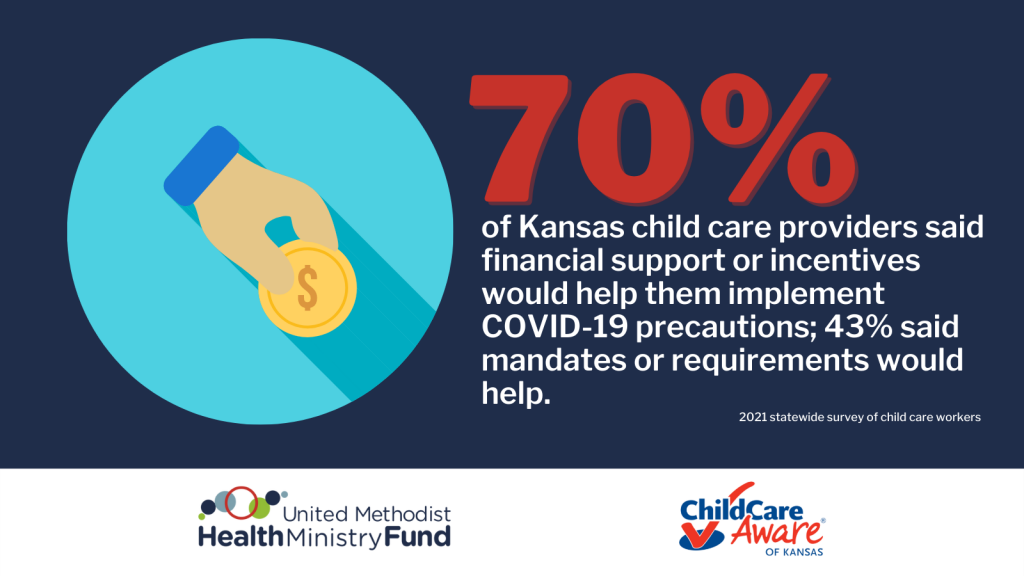
Most providers (70%) shared that financial support or incentives would help them implement COVID-19 precautions, while 43% said mandates or requirements would help.
Most programs reported that this time has been extremely stressful and has even caused many to consider closing their centers or home-based programs and seeking other forms of income. Many common themes emerged about the impacts of the pandemic, roadblocks they have faced, and ways they have adapted.
To ensure high-quality child care remains available across Kansas, policymakers and funders can provide financial support tied to specific and proven public health mandates, such as masking, testing or vaccination, in conjunction with educational materials and discussion guides to help maintain positive relationships between providers and families.
We need to work together on an integrated plan encompassing both short-term and long-term outcomes to prevent inequities in access to safe, high-quality child care among people of color, low-income communities, and rural and frontier counties.
New Health Fund Research Reveals that Kansas Providers See Future for Telehealth
After moving to temporarily expand access to telehealth early in the pandemic, its future is uncertain. A special committee will examine telehealth in preparation for the 2022 legislative session.
As the Legislature begins its discussion of telehealth and its impact on Kansans, the United Methodist Health Ministry Fund (Health Fund) is releasing new qualitative research focused on provider experience with telehealth.
To better understand how Kansas providers experienced telehealth, the Health Fund commissioned in-depth interviews with health care providers and administrators throughout Kansas that indicate that telehealth is here to stay—if reimbursements remain equivalent compared to in-person visits.
The interviewees represented a cross-section of urban, rural, and multi-site health care providers. Most of them had not offered telehealth services prior to the pandemic. Providers have since invested in equipment and technology. A key finding, mirroring previous research, is that for telehealth to remain viable, future financial support is needed for system upkeep and visit reimbursement.
Summary of Providers’ Perspectives
A summary of the providers’ perspectives on telehealth includes:
Telehealth increases access to care for specific populations such as those who are homebound or without transportation
Telehealth provides important access to services from home, cutting down patients’ travel time and making it easier for patients to balance work and raising family with accessing care
Technology (telehealth platforms, internet connectivity, device availability) is a large barrier to implementation
Telehealth is well-suited for many kinds of care, such as chronic care management, patient education and 1-on-1 counseling by mental health or substance use disorder providers
Most want to continue reimbursement for telehealth services or other public policies
Kansans want telehealth to continue beyond the pandemic. Kansas providers have invested in infrastructure and training. Our state has an opportunity to sustain telehealth beyond the pandemic. An initial provider survey, a statewide poll of voters, co-funded by the Health Fund and REACH Healthcare Foundation, and this set of in-depth interviews are evidence that telehealth can play a significant role in improving health care access for Kansans.
Is your organization eligible for American Rescue Plan Act (ARPA) funds? Is your organization prepared to apply for the ARPA funds and grants? What types of projects qualify for funding? This webinar presented by Julie Assel will help prepare your organization to best utilize ARPA resources. The webinar slides are available here.
Assel covers questions relating to hospitals, units of government, educational organizations, and nonprofits as well as information for new and seasoned grant writers.
Julie Assel is the President and CEO of Assel Grant Services. Assel is a professional grant writer with more than 15 years of experience. Her expertise is in federal level grants with the Department of Education, National Science Foundation, National Institute of Health, and the Environmental Protection Agency. Assel holds a Grant Professional Certification from the Grant Professionals Certification Institute and a Fundraising Certificate from the Midwest Center for Nonprofit Leadership.
Q: How do you register for the System for Award Management (SAM)? A: Please view the Quick Start Guide for New Grantee Registration.
Q: Where is ARPA money going in Kansas? A: Money will be available at the state, county, and local levels. $500 million which was given to the state is expected to be allocated by the end of 2021 with another $834 million expected to be allocated by the state in 2022.
Testimony presented by Health Fund President David Jordan to the KanCare Oversight Committee on Thursday, September 23, 2021.
Chair Hilderbrand, Vice Chair Landwehr, and Members of the Committee:
Thank you for the opportunity to provide public comment regarding maternal and child health issues in Kansas. I want to focus on the importance of extending postpartum coverage for new mothers enrolled in KanCare.
The United Methodist Health Ministry Fund (Health Fund) is a 35-year-old, $70 million health philanthropy located in Hutchinson. Our mission is to improve the health of Kansans. We focus on three strategic areas – access to care, early childhood development, and Healthy Congregations, a program aimed at addressing community health by engaging churches throughout Kansas. Over the last three decades we have provided more than $75 million in funding to improve the health of Kansans.
We support and invest in early childhood initiatives because research shows investing early creates the best health outcomes and the greatest return on investment.
One maternal and child health issue that has emerged during the pandemic that ties together our interests and investments is extending postpartum coverage for Kansas mothers enrolled in KanCare.
In 2018, Medicaid covered 39% of the 36,268 births in Kansas – 14,145 newborns. Prior to the public health emergency resulting from the COVID-19 pandemic, the majority of new mothers enrolled in KanCare would have lost their coverage 60 days after giving birth.
As a result of the ongoing public health emergency, Kansas cannot discontinue coverage for new mothers after 60 days. Kansas, like other states, has seen the benefits of this temporary policy change. Extending Medicaid coverage postpartum to 12 months enabled mothers to access critical health care and mental health services, ensuring mothers and babies have the healthiest start to life.
Recent federal policy change creates the opportunity for Kansas to extend coverage. Already, other states like Indiana and Tennessee are taking advantage of this opportunity.
Healthy mothers are important to building healthy families, which is why we need to act before the public health emergency ends. Otherwise, new mothers may lose their current health coverage to the detriment of their health, their children’s health, and long-term family stability.
Coverage Ends Too Soon: Maternal Mortality and New Mothers
Before the pandemic, pregnant Kansans were eligible for Medicaid coverage through the duration of their pregnancy and 60 days postpartum if their household income was at 171% or less of the federal poverty level. Although their newborn remained covered by Medicaid through their first year of life, the postpartum mother lost coverage on day 61 unless her household income was at 38% or less of the federal poverty level (FPL). A married woman with a single child would lose coverage on day 61 if her combined household income was above $8,345.
Before coverage was extended during the pandemic, each year in Kansas approximately 9,000 postpartum mothers lost Medicaid coverage 60 days after the end of pregnancy.
The Kansas Maternal Mortality Review Committee found that between 2016 and 2018 nearly one-quarter of all Kansas pregnancy-related deaths occurred between 43 days and one year postpartum. Nearly half of all pregnancy-associated deaths occurred in the same period.
According to a Kansas Department of Health and Environment (KDHE) Impact paper on postpartum coverage, “Findings from 2016-2018 cases revealed that women covered by Medicaid during pregnancy and delivery were more than three times as likely to die within one year of pregnancy when compared to women covered by private insurance. Among non-Hispanic Black women in Kansas, a greater proportion of pregnancy-associated deaths occurred during pregnancy (62.5%). Extending postpartum Medicaid coverage to 12 months creates opportunities to improve access to quality health care for high-risk populations, before, during, after and between pregnancies, potentially reducing pregnancy-associated deaths and closing the disparity gap . With many of the pregnancy-associated deaths involving health care and occurring months after delivery, these data suggest that a Medicaid postpartum coverage extension will help more women access care necessary to address critical, potentially fatal health concerns. National data published in February 2019 by the American Journal of Managed Care (AJMC) reveals that extending Medicaid coverage to 12 months postpartum is associated with 1.6 fewer maternal deaths per 100,000 women compared to rates for states that only provide coverage for the required 60-day time period.”
Having coverage and access to routine and preventive health care can help prevent these deaths that occur largely after coverage ends. Ending Medicaid eligibility for postpartum mothers after 60 days is too soon. We urge the state to take action to extend access to health care for Kansas mothers to prevent deaths and to reduce disparities.
Expanding Postpartum Coverage to 12 months Will Improve Health Outcomes in Kansas
The emergency extension of postpartum coverage during the pandemic has affirmed the value of extending a mother’s coverage. Mothers have been able to access critical health and behavioral health services.
Extending Medicaid coverage for a continuous 12 months postpartum can improve health outcomes for mothers, children, and families across the state. It is important to note that a child’s health is tied closely to their parent’s health and access to health care. Parental enrollment in Medicaid is associated with a 29% higher probability that a child will receive an annual well-child visit. Therefore, it is important for the health of the mother and child during the critical twelve-month period postpartum that both mother and child can access health care.
Nearly 20% of Kansas women below 200% of the federal poverty level experienced postpartum depression in the year after giving birth. It is vital that mothers have access to mental health and substance use services during this period because the postpartum period is a time when mothers are particularly susceptible to substance use relapse. Recognizing that according to KDHE, between state fiscal years 2012 and 2017, parental substance use was the primary reason that 70% of children under the age of one entered foster care, extending coverage to enable mothers to get substance use services can prevent interaction with the child welfare system.
Beyond improving health outcomes new mothers and children, extended postpartum coverage is also predicted to lead to a decrease in long-term Medicaid costs through the provision of early medical interventions and coordinated care, preventing postpartum complications and worsening chronic conditions due to a delay in early identification and intervention.
To recognize Kansas leaders working to improve the health and well-being of Kansans and to honor the visionary leadership of our founding president, in 2018 we began presenting an annual award – the Kim Moore Visionary Leadership Award – to an individual demonstrating exceptional leadership and dedication in one of our strategic funding areas. For 2020, we selected the field of early childhood development.
In Kansas, we’re fortunate to have many visionary leaders working to ensure our children enjoy the best possible start in life and have every chance to grow up happy, healthy, and equipped for success in school and life. The number of nominations we received is a testament to the great work and strong leadership Kansas enjoys in the early childhood field, and made it difficult to choose just one for this year’s award.
On behalf of the directors and team at the Health Fund we are excited to honor Deanna Berry, Executive Director of Russell Child Development Center, as the 2020 Kim Moore Visionary Leadership Award recipient for her work to advance the field of early childhood development in Kansas.
Ms. Berry has been advancing early intervention and education for more than 20 years, leading early childhood initiatives with a strong vision and voice informed by her comprehensive understanding of multiple communities and complex local, state, and national systems as well as current research and emerging trends in early childhood. Throughout her career, Deanna has continually and consistently looked for ways to meet the needs of children and families of all backgrounds and abilities so that young children can thrive.
Through Deanna’s leadership, Russell Child Development Center (RCDC) has become a tremendous resource for Kansas children and families, delivering multiple quality early childhood programs throughout rural and frontier counties encompassing nearly 16,000 square miles and serving as a trusted voice in the field, sharing knowledge and experience with the rest of the state for the benefit of all.
RCDC provides tiny-k (Part C Special Education) services in thirteen southwest Kansas counties, and is the recipient of Early Childhood Block Grant (ECBG) funds enabling programs such as Triple P (Positive Parenting Program), Growing Together, and Learn & Play groups to be provided in 19 Kansas counties. RCDC also provides ABC (Attachment and Biobehavioral Catch-Up), Child and Adult Food Program, and Targeted Case Management. Deanna oversees all of these programs.
Thanks to Deanna’s leadership, vision, and work, many families in southwest Kansas have become stronger, many children have received the appropriate services they needed to become successful, and all of this will ensure a brighter future in Kansas.