Author: Nancy McCready

Podcast episode 43: Beth Ludlum

Welcome to the Pioneers in Health podcast. In this podcast, we share inspiring stories of pioneering leaders from our nation and from your backyard who are working to improve health.

In episode 43, we interview Rev. Dr. Beth Ludlum. Beth serves as vice president for strategic initiatives and executive director of The Hub for (Re)Imagining Ministry at Wesley Theological Seminary in Washington, D.C. She also serves on the Health Fund’s Board of Directors.

In this episode, Beth shares how she grew up on a sixth-generation farm in southeast Kansas. She grew up active in her small Methodist church, where the older women taught her to bake bread and pray and the older men would tell her stories.

“Church was always a big part of my life,” she said, noting those early experiences really shaped her faith and identify.

Upon graduating high school, she left her small town to attend Kansas State University, where she majored in agricultural communications. While there, she began getting more and more involved in ministry. When graduation time rolled around, she struggled to find a job that felt right.

“I kept looking at jobs and thinking, this isn’t the right next step,” she said. “And so finally, a friend told me about this opportunity to teach in China. It was with a Christian organization, so kind of with the idea of going with eyes and ears toward what God was doing there, and that somehow just hit the right chord.”

She spent a year there, and fell in love with the people. Upon her return to the states, she shares how her career took a different path and led her into politics in Washington, D.C., and then ultimately into her current faith-based role.

She also discusses:

  • Her experience working in Washington, D.C., for U.S. Kansas Sen. Pat Roberts
  • Discovering a love of policy
  • Her journey into working in a faith-based role
  • Her decision to go to seminary and what she loves about ministry
  • Her passion for empowering young adult leadership and revitalizing ministry
  • What The Hub for (Re)Imagining Ministry does
  • The decline in church attendance
  • The role churches can play in their communities
  • The importance of lifting up the good in the world
  • What gives her hope

And much more! Listen now, and learn more about how Beth is an innovative leader in Kansas.


Listen now

Listen below or on any of your favorite podcast services. Like and subscribe to stay up-to-date with each new episode!


This image has an empty alt attribute; its file name is RSS-Feed.png
This image has an empty alt attribute; its file name is Apple-Podcasts.png
This image has an empty alt attribute; its file name is Spotify.png
This image has an empty alt attribute; its file name is Amazon-Music.png


Please see the Pioneers in Health page on our website for more information on our podcast series and links to other episodes.  

Podcast episode 42: Kari Bruffett

Welcome to the Pioneers in Health podcast. In this podcast, we share inspiring stories of pioneering leaders from our nation and from your backyard who are working to improve health.

In episode 42, we interview Kari Bruffett, president and CEO of Kansas Health Institute.

Kari, who grew up in western Kansas, began her career as a journalist for a small community newspaper in Paola, Kansas. There, she covered health care and government issues as part of her beat, which included localizing national health policy debate and covering an area hospital looking to expand into her county.

She also was able to interview U.S. Sen. Nancy Kassebaum during that time, who shortly after had a position open up in her office. Kari was hired for the position, which further introduced her to health care policy.

She shared about her experience going from covering local health policy to working on national health policies. She worked for both Kassebaum and U.S. Sen. Jerry Moran during her time in Washington, D.C.

“When I think about the kind of work that I’ve done, it really ties back to my strong belief that I really want folks to be able to live where they want to live, and where they live not to define their outcomes,” she said. “We know that’s such a real challenge in health care, but I didn’t know that that was going to be the sort of thing that was a motivating force for me when I first was starting out.”

Those experiences laid the foundation for a long career in health care and policy work.

In this episode, she also discusses:

  • Her career journey and the types of health policy she helped with along the way
  • Public health programs, including Medicaid
  • Behavioral health care
  • The Kansas Health Institute’s mission and work
  • How policy impacts health and vice versa
  • Opportunities that exist with rural health
  • Workforce development efforts
  • Policies they’re monitoring for this legislative session
  • Reimagining the health care system

And much more! Listen now, and learn more about how Kari is an innovative leader in health care.


Listen now

Listen below or on any of your favorite podcast services. Like and subscribe to stay up-to-date with each new episode!

This image has an empty alt attribute; its file name is RSS-Feed.png
This image has an empty alt attribute; its file name is Apple-Podcasts.png
This image has an empty alt attribute; its file name is Spotify.png
This image has an empty alt attribute; its file name is Amazon-Music.png


Please see the Pioneers in Health page on our website for more information on our podcast series and links to other episodes.  

Podcast episode 41: Chase Blasi

Welcome to the Pioneers in Health podcast. In this podcast, we share inspiring stories of pioneering leaders from our nation and from your backyard who are working to improve health.

In episode 41, we interview Chase Blasi, Kansas senator and Senate majority leader. He is a fifth-generation Kansan who grew up in West Sedgwick County and represents Senate District 26 in the Kansas Legislature.

In this episode, Senator Blasi discusses his background and how his interest was sparked in politics.

He first became interested in politics in 2010 while in high school — a time when the Tea Party made headlines and was coming into prominence. He became a volunteer for Mike Pompeo’s campaign for Congress, who successfully was elected to public office and went on to hold many high-level positions, including CIA director and secretary of state.

In 2017, he joined Kansas Senator Susan Wagle’s office while she served as president of the Senate. He then worked for Senator Ty Masterson’s office after that; he, too, served as president of the Senate. After working five years as a staffer, Chase decided to leave the Statehouse.

“Only then, four months later, my senator (Gene Suellentrop) resigned, and I thought, well maybe I should run for office and and run for the Senate,” he said. “And so next thing you know, four months later, I’m back in the Senate — not as a staffer, but now as a senator.”

He was elected in a precinct special election and is now entering his fourth year of service in the Senate and his second year as senate majority leader. He became the youngest person to serve in either position.

He also discusses:

  • Servant leadership
  • His experience as a young senator and the perspective that brings to the Legislature
  • How being a father makes him a better legislator
  • The high cost of child care
  • Efforts to pass a statewide ban on cell phones in schools and how he built a non-partisan coalition to support it
  • His focus on child health issues for the 2026 legislative session
  • Leadership Kansas
  • What gives him hope

And much more! Listen now, and learn more about how Senator Blasi is an innovative leader in Kansas.


Listen now

Listen below or on any of your favorite podcast services. Like and subscribe to stay up-to-date with each new episode!

This image has an empty alt attribute; its file name is RSS-Feed.png
This image has an empty alt attribute; its file name is Apple-Podcasts.png
This image has an empty alt attribute; its file name is Spotify.png
This image has an empty alt attribute; its file name is Amazon-Music.png


Please see the Pioneers in Health page on our website for more information on our podcast series and links to other episodes.  

Health Fund president named to national health board

Health Fund President and CEO David Jordan was elected to the national Grantmakers in Health Board of Directors this month.

Grantmakers in Health is a nonprofit, educational organization dedicated to helping foundations and corporate giving programs improve the health of all people. Its mission is to foster communication and collaboration among grantmakers and others, and to help strengthen the grantmaking community’s knowledge, skills, and effectiveness.

David joins Regan Gruber Moffitt, of St. David’s Foundation, as the newest members to the board.

“David and Regan bring deep experience in philanthropy and a powerful commitment to advancing better health for all, and we are excited for them to join the GIH board,” said Qiana Thomason, GIH Board Chair and President and CEO of the Health Forward Foundation. “We are grateful for their leadership, dedication, and willingness to serve.”

David’s three-year term begins in March.

“I am honored to be elected to serve on the Grantmakers in Health Board of Directors,” David said. “GIH is doing great work to support better health for all, and I am excited to support this important organization.”

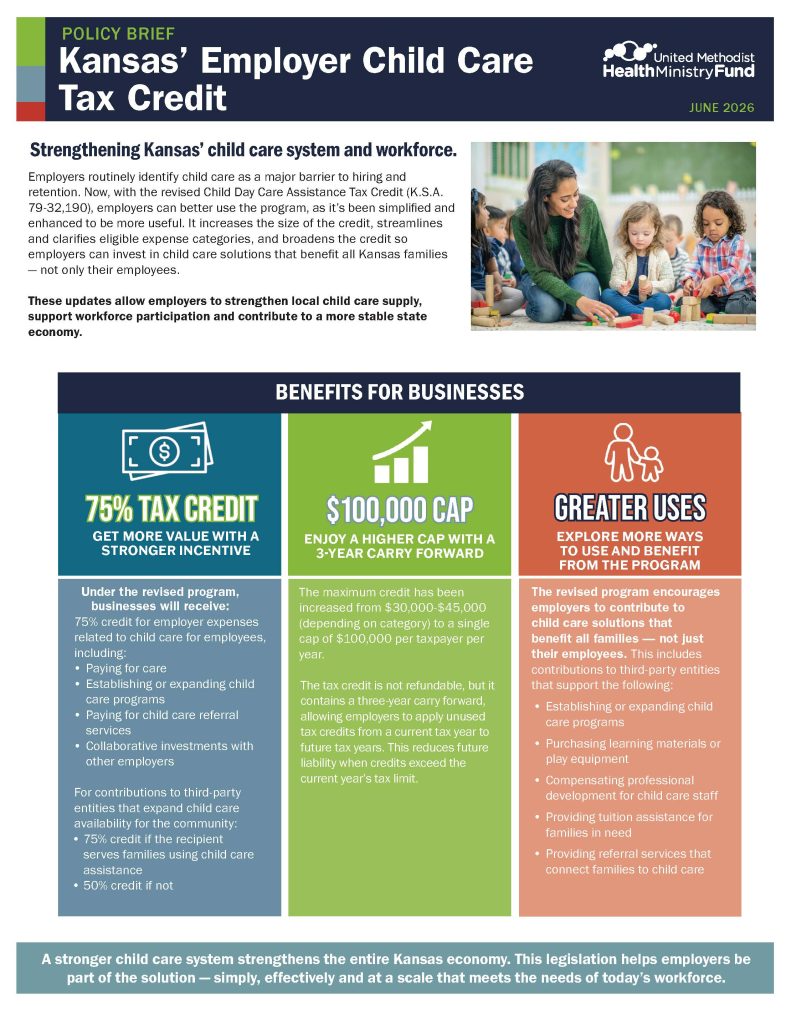
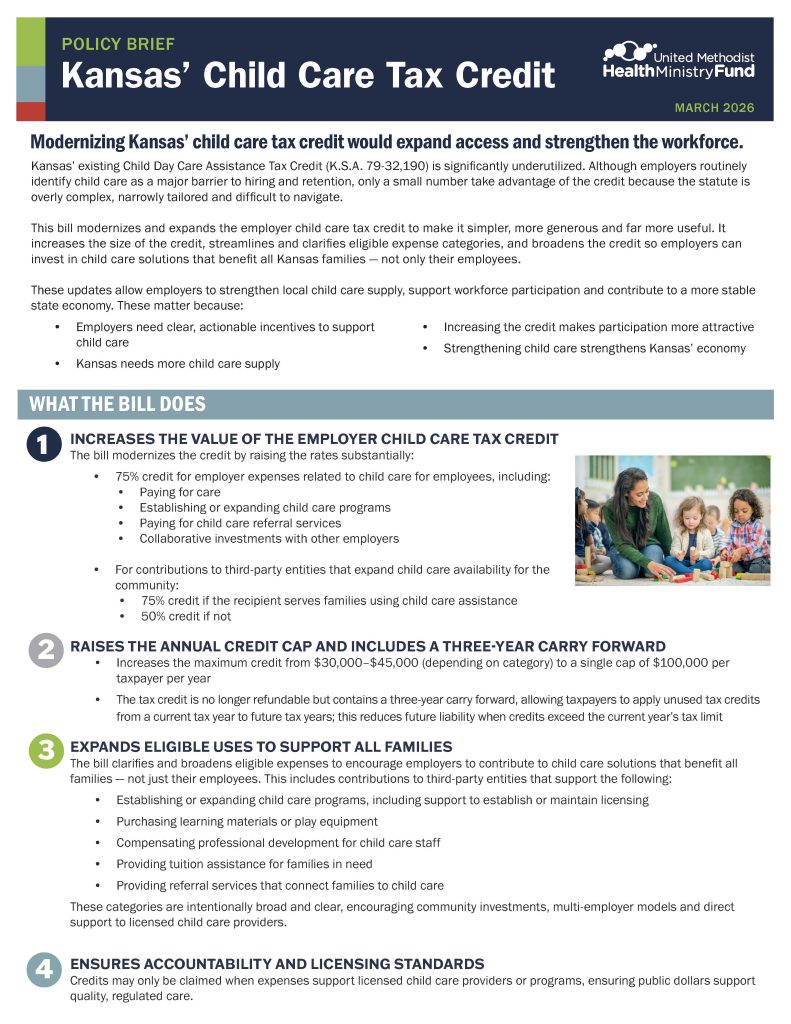
Child care subsidy program report, recommendations released

Access to affordable, high-quality child care is essential to the well-being of Kansas families, the strength of our workforce, and the long-term economic prosperity of our state.

Reliable child care allows parents to work, pursue education, and provide stability at home. For employers, it means a dependable workforce and stronger productivity. And for children, high-quality early care and education builds the foundation for healthy development and lifelong learning. When families can find and afford the care they need, the benefits ripple across local businesses, communities, and the entire state.

A cornerstone of this system is Kansas’ Child Care Assistance Program, which helps families offset the cost of care through subsidies. When administered effectively, these subsidies enable parents to join or remain in the workforce, pursue education or training, and provide stability for their children — while also giving providers the predictable revenue needed to sustain their programs and deliver high-quality care.

Yet, in Kansas, only 7.4% of potentially eligible children are currently served by the program. To better understand the barriers and identify solutions to increase participation, the Health Fund supported a research initiative that took an honest, data-driven look at how the program is functioning today and where improvements are most needed.

This report, released publicly in January 2026, provides recommendations on what actions could improve access for families and increase participation by child care providers. View the full report or the research brief below.


Download full report

Download research brief

Watch webinar

Podcast episode 39: Janet Stanek

Welcome to the Pioneers in Health podcast. In this podcast, we share inspiring stories of pioneering leaders from our nation and from your backyard who are working to improve health.

In episode 39, we interview Janet Stanek, secretary of the Kansas Department of Health and Environment. Janet Stanek is the Secretary of the Kansas Department of Health and Environment (KDHE), appointed by Governor Laura Kelly. KDHE has three divisions, including Health, Environment, and Health Care Finance, which includes the Medicaid program (KanCare) and the State Employee Health Benefits Plan, where Stanek previously served as the Director.

Secretary Stanek has worked in health care for more than 40 years, but her initial sights were elsewhere. They were on computer science. However, after just one year in college, she knew it wasn’t for her.

A college guidance counselor encouraged her to look at a new emerging field called medical record technology.

“He said computers were going to play a big role in that,” she said. “And he was right.”

She completed a two-year degree in medical record technology and then obtained a bachelor’s degree in medical record administration. And so began her career in health care.

She first worked as a medical biller in a small hospital and then worked her way up to COO and senior vice president at Stormont Vail Health, a large hospital in Topeka. She said her experience working in small, critical-access hospitals was invaluable to her career.

“In those hospitals, you learn a lot, and I would say that was the bedrock of my advancement to bigger hospitals and learning so much more, because everything replicates to a bigger scale,” she said.

In this episode, she shares highlights from her time in hospital administration.

She also discusses the evolution of technology in medical record keeping and lessons that apply to today’s newest technology with artificial intelligence.

She also discusses:

  • How the health care landscape has changed throughout her career
  • Workforce shortages
  • Her experience as director of the State Employee Health Benefits Program
  • The challenges large employers face in keeping health care costs down while maintaining robust coverage for employees
  • The importance of employee satisfaction
  • The role of KDHE
  • Efforts to strengthen public health
  • KanCare 3.0
  • How KDHE is working to mitigate current challenges, including federal budget cuts
  • How KDHE supports strengthening health care in rural communities
  • The Rural Health Transformation Fund
  • What gives her hope

And much more! Listen now, and learn more about how Secretary Stanek is an innovative leader in health care.


Listen now

Listen below or on any of your favorite podcast services. Like and subscribe to stay up-to-date with each new episode!

This image has an empty alt attribute; its file name is RSS-Feed.png
This image has an empty alt attribute; its file name is Apple-Podcasts.png
This image has an empty alt attribute; its file name is Spotify.png
This image has an empty alt attribute; its file name is Amazon-Music.png


Please see the Pioneers in Health page on our website for more information on our podcast series and links to other episodes.  

New webinar: Learn about Kansas’ child care subsidy system

What changes could improve the state’s child care subsidy system? Join our webinar at noon Jan. 8 to hear what Kansas families and providers had to say.

Access to affordable, high-quality child care is essential to the well-being of Kansas families, the strength of our workforce, and the long-term economic prosperity of our state.

Reliable child care allows parents to work, pursue education, and provide stability at home. For employers, it means a dependable workforce and stronger productivity. And for children, high-quality early care and education builds the foundation for healthy development and lifelong learning. When families can find and afford the care they need, the benefits ripple across local businesses, communities, and the entire state.

A cornerstone of this system is Kansas’ Child Care Assistance Program, which helps families offset the cost of care through subsidies. When administered effectively, these subsidies enable parents to join or remain in the workforce, pursue education or training, and provide stability for their children — while also giving providers the predictable revenue needed to sustain their programs and deliver high-quality care.

Yet, in Kansas, only 7.4% of potentially eligible children are currently served by the program. To better understand the barriers and identify solutions to increase participation, the Health Fund supported a research initiative that took an honest, data-driven look at how the program is functioning today and where improvements are most needed.

Podcast episode 38: Mark Fleury

Welcome to the Pioneers in Health podcast. In this podcast, we share inspiring stories of pioneering leaders from our nation and from your backyard who are working to improve health.

In episode 38, we interview Mark Fleury, principal of policy development-emerging science at the American Cancer Society Cancer Action Network. He specializes in research, drug development, and regulatory policies, along with other science and technology-related projects.

In this episode, Mark discusses growing up in Kansas and how a love of math and science as a kid led him to becoming an engineer, where he saw an opportunity to make a difference. He majored in chemical engineering with an environmental minor at Kansas State University.

“What drew me there was the chance to use math and science to solve real-world problems,” Mark said.

Upon graduation, he went to work for Cargill for a number of years, where utilized his skills to design industrial wastewater treatment plants and then oversaw them being constructed. He found great satisfaction in seeing a project from the design phase through completion.

However, Mark began realizing he wanted to use his problem-solving skills in a different way and went back to school to pursue a PhD. He wanted to pursue public health and tackle problems related to disease.

“I realized that policy was a way to drive the science to create an environment that was conducive for those discoveries to make their way into new therapies and treatments for patients,” he said.

Mark received an opportunity to work in Senator Claire McCaskill’s office in Washington, D.C., at a time when the Affordable Care Act was being debated. During that time, he learned an extensive amount about how to deliver and pay for health care.

From there, he eventually found his way to working on cancer research and policy — and ultimately found his way to the American Cancer Society Cancer Action Network, where he works today within the emerging science portfolio of work.

“Our work really is across the continuum of cancer — from before you even know you have cancer to well into the journey,” he said.

“The best and most innovative treatments in the world are of little use if you can’t access them and don’t have an ability to pay for them,” he said.

He also discusses:

  • The purpose of the Cancer Action Network
  • Cancer research
  • Biomarkers and pharmacogenomic testing, which studies how a person’s genetic makeup affects their response to specific drugs
  • Clinical trials
  • The importance of early detection
  • Efforts to drive more investment in childhood cancers
  • Drug shortages

And much more! Listen now, and learn more about how Mark is an innovative leader in health care.


Listen now

Listen below or on any of your favorite podcast services. Like and subscribe to stay up-to-date with each new episode!

This image has an empty alt attribute; its file name is RSS-Feed.png
This image has an empty alt attribute; its file name is Apple-Podcasts.png
This image has an empty alt attribute; its file name is Spotify.png
This image has an empty alt attribute; its file name is Amazon-Music.png


Please see the Pioneers in Health page on our website for more information on our podcast series and links to other episodes.  
Advent series: Helping the hungry

Advent resources support special focus on helping the hungry.

As people of faith, our hearts and our values call us to feed the hungry. Our commitment to justice, mercy and love in action drives us to come together toward a future where families and children no longer fear whether they’ll eat tomorrow.

This Advent season, the Health Fund has partnered with the Great Plains Conference to offer resources to help raise awareness of the profound impacts of food insecurity and to illustrate how each of us can help.

These resources will include lectionary scripture, worship liturgy, a church bulletin and additional facts about food insecurity in Kansas and Nebraska.

We encourage you to use these resources throughout Advent to help shine a light of hope, joy and love this Christmas season. 


Week 1

Church bulletin: To be printed on an 8.5×11 and then cut in half

Lectionary scripture and worship liturgy:


Week 2

Church bulletin: To be printed on an 8.5×11 and then cut in half

Lectionary scripture and worship liturgy:


Week 3

Church bulletin: To be printed on an 8.5×11 and then cut in half

Lectionary scripture and worship liturgy:


Week 4

Church bulletin: To be printed on an 8.5×11 and then cut in half

Lectionary scripture and worship liturgy:

Podcast episode 37: Jodi Schmidt

Welcome to the Pioneers in Health podcast. In this podcast, we share inspiring stories of pioneering leaders from our nation and from your backyard who are working to improve health.

In episode 37, we interview Jodi Schmidt, executive director of the Care Collective at the University of Kansas Health System. The Care Collaborative is a patient safety organization dedicated to delivering high-quality clinical care to improve the health of people living in rural Kansas communities. Founded in 2014 and accredited by the Agency for Healthcare Research and Quality, the collaborative is a network of health care providers and care teams who use evidence-based treatment models to achieve the best outcomes.

Jodi is also past president of the National Rural Health Association and representative to the American Hospital Association’s Small and Rural Hospital Governing Council; past chair of the Kansas Hospital Education and Research Foundation and member of the Kansas Hospital Association’s Rural Emergency Hospital task force; and Sunflower Health Plan’s rural and community advisory boards. 

In this episode, Jodi shares how she pursued journalism in college and never intended to work in health care. However, she graduated at a time when health care organizations were realizing they needed to communicate with their patients and communities. So, she accepted a job with Hadley Regional Medical Center as the first communications professional to help them develop a strategic communications plan.

“You could see in action what was possible when you connected resources across a region and saw the opportunity that it brought to patients to expand access to care through that sort of networking,” she said. “So at that point, in the late 80s and early 90s, I was hooked, and I’ve been in rural health care in Kansas in one way, shape or form ever since.”

She also discusses:

  • The ability for rural health care facilities to innovate and react quickly
  • Challenges for rural hospitals
  • Her experience as a hospital CEO in southeast Kansas
  • Expanding the availability of low-cost food
  • Managing health
  • Her experience serving as the president of the National Rural Health Association
  • The Care Collaborative and its mission and initiatives
  • The Medicare Shared Savings Program
  • The Rural Health Transformation Program

And much more! Listen now, and learn more about how Jodi is an innovative leader in health care.


Listen now

Listen below or on any of your favorite podcast services. Like and subscribe to stay up-to-date with each new episode!

This image has an empty alt attribute; its file name is RSS-Feed.png
This image has an empty alt attribute; its file name is Apple-Podcasts.png
This image has an empty alt attribute; its file name is Spotify.png
This image has an empty alt attribute; its file name is Amazon-Music.png


Please see the Pioneers in Health page on our website for more information on our podcast series and links to other episodes.  
© United Methodist Health Ministry Fund