Welcome to the Pioneers in Health podcast. In this podcast, we share inspiring stories of pioneering leaders from our nation and from your backyard who are working to improve health.
In episode 26, we interview Mike Matson. He is a lifelong Kansan whose career has touched various aspects of communications: radio and TV news, press secretary to a governor, systems advocacy, newspaper columnist, deejay and podcast/radio talk show host.
He also has authored two books that center on alcoholism – one a family memoir of growing up in an alcoholic home and one about his own story of addiction.
Today, Mike is semi-retired but hosts a live daily radio talk show/podcast created to foster critical thinking and writes a column for his local newspaper, the Manhattan Mercury.
In this episode, he discusses his journey into broadcasting and his early career as a radio and news TV reporter. He went on to work as a political reporter, which led to a new chapter in his career in government and politics.
That experience and interest in politics ultimately led to a position working in politics himself. He decided to leave a successful career as a journalist to join Bill Graves’ gubernatorial campaign in the mid-90s.
“I was getting a steady paycheck every two weeks. I was doing a great job. I loved the work. And I was giving all that up for something as iffy as a political campaign,” he said. “It felt right at the time, and as it turned out, he did get elected.”
Graves became the 43rd governor of Kansas in 1994, and Mike became his communications director. He shares how seeing that government could serve as a force for good drew him to the public sector and what it was like working in politics at that time.
He also discusses:
Working for the Kansas Farm Bureau and his communications efforts for the organization, especially in rural communities
The changing demographics in rural Kansas, including communities becoming older and more culturally diverse
His experience in advocacy
His challenges with substance use
The two books he’s authored, including a family memoir called “Spifflicated,” and a book called “Courtesy Boy” about his experience with addiction as an alcoholic
And much more! Listen now, and learn more about how Mike has been an innovative leader in Kansas.
Listen now
Listen below or on any of your favorite podcast services. Like and subscribe to stay up-to-date with each new episode!
Please see the Pioneers in Health page on our website for more information on our podcast series and links to other episodes.
David Jordan, president and CEO, United Methodist Health Ministry Fund, 508-246-6825, david@healthfund.org
Brenda Sharpe, president and CEO, REACH Healthcare Foundation, 913-322-6025, brenda@reachhealth.org
New report: Kansas to lose $3.77 billion in Medicaid funding under ‘One Big Beautiful Bill,’ thousands to lose access to health insurance
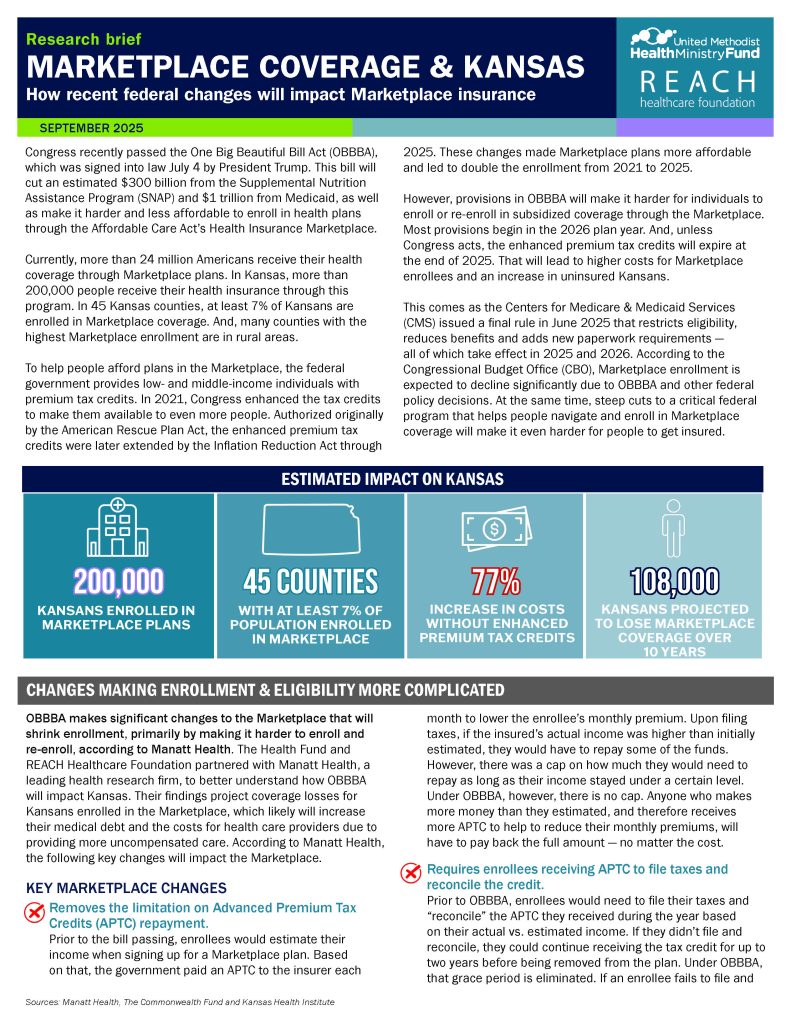
HUTCHINSON, KS – New modeling shows 13,000 fewer Kansans would be able to enroll in Medicaid under the “One Big Beautiful Bill” recently passed by the U.S. House, and the state would lose $3.77 billion in total Medicaid funding. Such losses would lead to higher uninsured rates and create more financial struggles for rural hospitals already on the brink of closure.
These results were recently released by Manatt Health, which conducted the analysis at the request of Kansas health philanthropies United Methodist Health Ministry Fund and REACH Healthcare Foundation. The two organizations wanted to better understand the financial and enrollment impacts of the bill, which would cut $700 billion from Medicaid and is awaiting a vote in the Senate.
Medicaid, the public health insurance program that covers more than 366,000 Kansans, is funded jointly by the state and federal government. It provides low-income parents, children, seniors and people with disabilities with health insurance. Adults who do not have children do not qualify for Medicaid in Kansas.
While many of the bill’s deepest funding cuts and new restrictions are aimed at states that expanded Medicaid to cover more people, the analysis shows Kansas will still face significant coverage losses and funding reductions over the next 10 years.
“If this bill passes, it will cause long-lasting harm to thousands of families across Kansas and seriously threaten the survival of rural hospitals across the state,” said Brenda Sharpe, president and CEO at REACH Healthcare Foundation.
Manatt said the losses are even greater than shown in the analysis, as data limitations made it unable to model all the provisions in the bill. The estimates do not account for prohibitions on states setting up any new provider taxes or increasing assessments for other providers. That will cause Kansas health care providers, including nursing homes and other health providers, to lose critical funding over time and cause them to become even more financially vulnerable.
Coverage losses due to the bill’s changes to the Affordable Care Act’s Health Insurance Marketplace also couldn’t be modeled; however, they will result in additional Kansans losing health insurance.
Not only will the bill remove people’s health insurance, but it also will remove food assistance. The bill includes $300 billion in cuts from the Supplemental Nutrition Assistance Program (SNAP).
“Congress is trying to rush a plan through the process that will take health care and food assistance away from tens of thousands of Kansans, including children, seniors and people with disabilities,” said David Jordan, president and CEO at the Health Fund. “At a time when hospitals are trying to keep their doors open and working families are struggling to keep a roof over their heads and food on their tables, we cannot afford these cuts.”
Kansas already has more hospitals at risk of closure than any other state in the country. Sixty-three rural hospitals are currently at risk, and 87% of Kansas rural hospitals are operating in the red. These hospitals struggle to survive with existing federal funding. Provisions in the bill would cause them to lose billions, making it even harder to stay open. When rural hospitals close, it removes job opportunities in addition to access to health care, creating a ripple effect in small communities.
About the United Methodist Health Ministry Fund and REACH Healthcare Foundation The United Methodist Health Ministry Fund (Health Fund) is a statewide health foundation working to improve the health of all Kansans since 1986 by funding innovative ideas, sparking conversations and convening those who can make a difference. Learn more at www.HealthFund.org
REACH Healthcare Foundation is a charitable foundation dedicated to improving health coverage and access to quality, affordable healthcare for uninsured and medically underserved people. The foundation focuses its support in a six-county service area that encompasses Allen, Johnson, and Wyandotte counties in Kansas and Cass Jackson and Lafayette counties in Missouri, as well as the City of Kansas City, Missouri. Learn more about the foundation at www.reachhealth.org.
About Manatt Health Manatt Health is a leading professional services firm specializing in health policy, healthcare transformation, and Medicaid redesign. Their modeling draws upon publicly available state data including Medicaid financial management report data from the Centers for Medicare and Medicaid Services, enrollment and expenditure data from the Medicaid Budget and Expenditure System, and data from the Medicaid and CHIP Payment and Access Commission. The Manatt Health Model is tailored specifically to Kansas.
Welcome to the Pioneers in Health podcast. In this podcast, we share inspiring stories of pioneering leaders from our nation and from your backyard who are working to improve health.
Haley engages Kansans in anti-hunger advocacy, building grassroots campaigns and strategies to increase voter turnout related to hunger policy. Her dedication to equity and fairness drives her efforts in policy and legislative action for justice.
In this episode, Haley discusses her journey into advocacy. She shares the formative experience of becoming a caretaker at a young age for her mother, who developed a rare form of muscular dystrophy.
“That really did shape the way I see the world and how I want to see justice and equity and dignity for all,” she said.
She saw firsthand how hard it was for her mom to access basic things, such as health care and going to the doctor, mobility challenges she faced and even how she was treated by others.
“I learned very quickly the system was not built for people like my mom, who were in a wheelchair and breathed on a ventilator, and that really did leave a lasting impression on me,” she said. “That has really driven my advocacy work. …It shaped me to believe that we really can believe and build a world where people don’t have to fight so hard for what should be fundamental rights for them, and because of that, I believe that policy can really be a tool for that. That’s really why I am here working in Kansas on advocacy.”
At Kansas Appleseed, she focuses her efforts on food access, including the federal Supplemental Nutrition Assistance Program (SNAP) and child nutrition programs, such as summer school meal programs. She said about 1 in 5 Kansas children face food insecurity – not knowing where their next meal will come from.
“We know it’s a pervasive issue, and unfortunately, there has not been much done to make any headway on eradicating hunger in Kansas,” Haley said.
She said the SNAP program, which was formerly called food stamps, is the most effective way to address food insecurity in Kansas and across the country. SNAP not only helps people afford groceries, but it also improves health outcomes and provides stability to help people get back on their feet.
SNAP provides support to working families with low-paying jobs, low-income seniors, people with disabilities living on fixed incomes, and other people with low incomes. The program’s benefits are paid for by the federal government, but the cost to administer it is shared with each state.
“We are straining the same families with these proposals just to make tax breaks for the wealthiest Americans, and it’s just not sitting right with me.”
– Haley Kottler on proposed cuts to programs that provide food assistance and health insurance to vulnerable Americans
“I think it’s a big, bad bill, if I’m being honest,” she said. “…It proposes disastrous, substantial cuts and sweeping changes to federal safety net programs, including SNAP.”
In Kansas, SNAP supports over 200,000 people, with the majority of those children and seniors, she said.
Haley said the current bill passed by the U.S. House of Representatives, known as the “big, beautiful bill,” is the most significant threat she’s ever seen to the program. The bill proposes over $300 billion in cuts to SNAP as part of an effort to extend tax cuts for wealthier Americans.
Haley discussed how the bill’s current work requirements are damaging and how the bill could terminate millions of people’s access to SNAP. She also addressed myths surrounding work requirements and SNAP, highlighting that most people who receive SNAP benefits already work.
Additionally, the bill would shift more of the program’s cost to states, further straining state budgets and likely resulting in additional cuts to the program. Benefits are already meager in Kansas, she said, with families receiving just about $6 per day per person.
She discussed how the proposed bill also would impact people on Medicaid, the public insurance program that provides health insurance to low-income families, seniors, pregnant women and people with disabilities. More than $800 billion could be cut from Medicaid.
“We are straining the same families with these proposals just to make tax breaks for the wealthiest Americans, and it’s just not sitting right with me,” she said.
In this episode, she also discusses:
The mission of Kansas Appleseed
The difference between hunger and food insecurity
How cuts to SNAP could also remove families from access to free-and-reduced meals for their school-aged children
Efforts to change reduced-priced meals to free meals for qualifying families
The benefits of food security for children, especially while they are in school
What gives her hope for the future
And much more! Listen now, and learn more about how Haley is an innovative leader in health care.
Listen now
Listen below or on any of your favorite podcast services. Like and subscribe to stay up-to-date with each new episode!
Please see the Pioneers in Health page on our website for more information on our podcast series and links to other episodes.
From left: Outgoing Board Chairperson Lori Hartnett, Treasurer Lynette Juresic and Director Monte Wentz
The Health Fund staff and Board of Directors said goodbye to three longtime board members this month.
Outgoing Board Chairperson Lori Hartnett, Treasurer Lynette Juresic and Director Monte Wentz all attended their last meeting in May.
Each member contributed immensely to the organization during their years of service to the organization. All three joined the Board of Directors in 2016.
LORI HARTNETT Upon joining, Lori served on the Program and Evaluation Committee for seven years, including five years as chair. She later contributed her expertise to both the Executive and Governance committees. Demonstrating strong leadership throughout her tenure, Lori went on to serve as vice chair of the Board of Directors before assuming the role of chairperson from 2023-25.
LYNETTE JURESIC Lynette, a certified public accountant, lent her financial expertise throughout her 11 years of involvement with the Health Fund. Prior to joining the Board of Directors in 2016, she served as a Finance Committee member for two years.
Upon joining the board, she continued to serve on the Finance Committee and later joined the Investment and Executive committees, as well. She held multiple leadership roles throughout her tenure, including serving for five years as both the chair of the Finance Committee and treasurer for the Board of Directors.
MONTE WENTZ Monte served on the Investment Committee upon joining the board, where he remained an active member throughout his tenure. He later joined the Governance Committee, providing leadership as chair for five of his six years with the committee. He also served on the Executive Committee, where he further contributed to the direction of the organization.
All three members oversaw the Health Fund through significant times of change, including a change in organizational leadership after long-time former President Kim Moore retired in January 2018 and then the COVID pandemic in 2020-21.
“We deeply appreciate these three board members and the time they dedicated to our organization,” Health Fund President and CEO David Jordan said. “Their steadfast support, encouragement and belief in our mission throughout their tenure has been invaluable. We’ll sincerely miss having them as part of the board.”
During their last meeting in May, Lori ceremoniously transferred the chairperson role to longtime board member Matthew Penner. The board will welcome its new incoming directors during the September 2025 board meeting.
Welcome to the Pioneers in Health podcast. In this podcast, we share inspiring stories of pioneering leaders from our nation and from your backyard who are working to improve health.
In episode 24, we interview Becca Graves, executive director at Perigee Fund. The Perigee Fund is a philanthropy that focuses on increasing support for families impacted by trauma. It invests in systems change to ensure that during pregnancy and early childhood, more families receive healing programs, services and resources that protect and nurture their unfolding relationships.
In this episode, Becca discusses her economic mindset and a twist of fate that led to her working in philanthropy.
She discusses how in a previous role she was part of many conversations where people discussed the long-term impact of childhood trauma on adults or how to support high school students who had experienced early trauma.
“I was always in the room thinking, why are we not doing something earlier?” Becca said.
“Mental health begins before birth, and the well-being of parents as they expect a child is incredibly important.”
– Becca Graves
Becca discusses the importance of this and how it’s critical to address mental health during pregnancy, as it’s not only important for the parents, but it’s also where mental health for a child begins.
“Mental health begins before birth, and the well-being of parents as they expect a child is incredibly important,” she said. “Maternal mental health complications during pregnancy and postpartum are incredibly common. Maternal depression is the one of the original ACEs. And, largely, maternal mental health complications are preventable and treatable.”
ACEs refers to Adverse Childhood Experience score, which is derived from a questionnaire that measures exposure to different types of adverse childhood experiences, such as abuse, neglect or household dysfunction.
“Addressing the well-being of children absolutely starts with their caregivers,” Becca said.
Perinatal mental health specialists are few and far between, she said, so she said they’ve invested in perinatal psychiatry around the country for physicians.
She also discussed Perigee’s efforts to affect policies and system change, which often centers on efforts to treat the baby and caregiver as a family unit instead of as individuals. At this stage of life, the relationship between the two is critically important.
“They should receive care that is connected,” she said. “There is a phrase in the infant mental health world that there’s no such thing as a baby on its own. It’s always a baby and a caregiver together. So, a lot of the policy innovation can be very, very specific to changing practice to serve the family as a unit.”
In this episode, she also discusses:
Her journey to working at the Perigee Fund
Perigee’s approach to mental health
How addressing the well-being of children starts with addressing the caregivers’ well-being; she mentions the Attachment and Biobehavioral Catch-up home-visiting program, a model the Health Fund supported to determine its efficacy in Kansas
How health insurance, including the public health insurance program Medicaid, is critical for helping mothers and babies
The importance of nurturing the bond between parents and their child
The growing maternal-care desert in Kansas is causing more women in the state to drive long distances for care, with 59% not having any local access to inpatient maternity services.
Over the last 10 years, many rural hospitals across the country have closed or have stopped offering maternity care services altogether. This includes in Kansas, which is second only to Texas in terms of the number of counties considered rural. Rural hospitals are at an increased risk of closure due to declining occupancy rates, high fixed costs and market pressures.
Access to quality perinatal care, which includes care during pregnancy and after the birth, is critical to the health of newborn babies and their mothers. Closures of hospitals and cessation of maternity services are correlated with more babies being born early, more infants admitted to neonatal intensive care units and more women dying during pregnancy or in childbirth.
The report outlines, by county and ZIP code when possible, the numbers of women of reproductive age in the area, the facilities offering prenatal care or inpatient maternity care; the availability of referral and high-risk services; and the providers accepting patients and offering prenatal or full perinatal services, nursing, anesthesia, behavioral health, lactation, and doula support services. It also provides the distances to facilities with delivery capabilities.
Findings from this report were shared during a webinar June 12, 2025. Below, find the recording and materials provided during the webinar.
Lead report author:Karen Weis, Ph.D., FAAN, dean of KU School ofNursing-Salina and Christine A. Hartley Rural Health Nursing professor, followed by a panel discussion with maternal and rural health experts.
Pictured from left: Kelly Moffatt CHW-C, PCHS; Jennifer Dodds, LBSW, PCHS;Lori Hartnett, Health Fund board chair; David Jordan, Health Fund president and CEO.
HUTCHINSON, KS — The Health Fund honored Phillips County Health Systems with its 2024 Janet Sevier Gilbreath Special Project Recognition Award during a ceremony May 6 in Hutchinson, Kansas.
This annual award celebrates a standout project that received grant support during that year from the Health Fund.
Phillips County Health Systems (PCHS) was honored for its exemplary community health worker (CHW) program, which it began and has continued since 2021 with support from the Health Fund.
CHWs are trusted community members professionally trained to help people navigate the health care system. They also work with individuals to identify difficulties and develop plans to overcome challenges.
CHWs have extensive knowledge of community resources and services, so they can connect people to the medical and social services they need to improve their health outcomes. They often provide community outreach and education, informal counseling, social support and advocacy. As valued members of health care teams, CHWs enable medical providers to work at the top of their scopes of practice and ensure continuity of care.
PCHS’ program has built relationships with local pharmacies, the Health Department, the Area Agency on Aging, the Ministerial Alliance, Meals on Wheels, Home Health agencies and more. By building trust, the program has helped PCHS gain new patients as well as increase patient retention and satisfaction.
“As a CHW, I can go beyond the hospital walls and visit with patients in their safe spaces. Health care can be very intimidating to some, and the CHW is there to build the bridge between the patient and their best overall health and wellness. We not only address the issue at hand, we dive in to find out the why behind the illness. We can do this in hospitals, clinics, health departments and more,” said Kelly Moffatt, PCHS CHW.
The program got a client into a much-needed drug and alcohol program, helped another secure financial support for insulin, and found local businesses and volunteers to help an elderly woman pack and move to safer housing. In another success, a patient receiving help applying for Medicaid, food assistance, disability, prescription assistance, and energy assistance had a mammogram shortly before her insurance was cancelled. An urgent biopsy was recommended but declined due to cost. The CHW connected the patient to Early Detection Works, which expedited her Medicaid application and saw her through successful treatment for stage two breast cancer.
Katie Schoenhoff, Health Fund vice president of programs, said PCHS has demonstrated outstanding dedication in advancing the community health worker initiative. By broadening their care team and integrating social drivers of health into their approach, they are ensuring individuals receive the medical care, resources and support they need to improve their overall well-being.
“Their commitment to expanding the role of community health workers has not only enhanced access to essential care, but it has also strengthened the compassionate support available to residents,” Schoenhoff said. “We are proud to recognize their initiative and unwavering service to the community as a model for rural health excellence.”
The Health Fund commissioned a report by KU School of Nursing, who worked in collaboration with the Kansas Center for Rural Health, to conduct research on access to maternity care in Kansas. The report was released May 8, 2025. This story below announcing the reportoriginally appeared on KU Medical Center’s website.
Report describes the state’s maternity care desert and provides detailed information on the critical resources needed to ensure healthy mothers and babies
May 8, 2025 | Kristi Birch, KU Medical Center
Access to quality care during pregnancy and after birth, often difficult to access in rural areas, is critical to the health of newborn babies and their mothers.
The growing maternal-care desert in Kansas is causing more women in the state to drive long distances for care and 59% do not have local access to inpatient maternity services, according to a report released today by the University of Kansas School of Nursing.
Over the last 10 years, many rural hospitals across the country have closed or have stopped offering maternity care services altogether. This includes in Kansas, which is second only to Texas in terms of the number of counties considered rural. Rural hospitals are at an increased risk of closure due to declining occupancy rates, high fixed costs and market pressures.
“Kansas legislators, health care systems, foundations, professional organizations and educational institutions are all working hard to address the concerns of access to care and the health care workforce,” said Karen Weis, Ph.D., FAAN, dean of KU School of Nursing-Salina and lead author of the report. “Sound data is needed to support these efforts. The Access to Maternal Care in Kansas report is a first step in gathering that data in one central source.”
Access to quality perinatal care, which includes care during pregnancy and after the birth, is critical to the health of newborn babies and their mothers. Closures of hospitals and cessation of maternity services are correlated with more babies being born early, more infants admitted to neonatal intensive care units and more women dying during pregnancy or in childbirth.
The report outlines, by county and ZIP code when possible, the numbers of women of reproductive age in the area, the facilities offering prenatal care or inpatient maternity care; the availability of referral and high-risk services; and the providers accepting patients and offering prenatal or full perinatal services, nursing, anesthesia, behavioral health, lactation, and doula support services. It also provides the distances to facilities with delivery capabilities.
Karen Weis, Ph.D., FAAN, dean of KU School of Nursing-Salina
Key findings in the report, which is based on data from 2022-2024, include:
An increasing number of Kansans travel up to 60 miles for low-risk prenatal and postpartum and labor and delivery care, particularly in the central and southwest parts of the state.
Fifty-nine percent of Kansans do not have local access to inpatient maternity care.
The availability of services for women with high-risk pregnancies is extremely limited. Close to 30% of ZIP codes in Kansas are more than 100 miles away from tertiary, high-risk services.
Forty-two counties in Kansas are without any documented anesthesia providers, and most of those are on the western side of the state.
The report also found that the counties with the highest birth rates are the ones losing access to maternity care services. And rural counties had higher birth rates than urban ones: 67 versus 61 live births per 1,000 women of reproductive age.
“To me, the biggest surprise in the report are the two counties in western Kansas with the highest birth rates,” said Weis. Neither of these counties, Wallace and Grant, have a health care system offering maternity care. The distance to inpatient maternity care for those residing in each county is approximately 50 miles and 24 miles, respectively.
The report also provides information clarifying the unrecognized costs of providing maternal health care, which requires the presence of multidisciplinary teams of providers and nurses 24 hours a day, 7 days a week, 365 days a year. The vast majority of rural hospitals are reimbursed through a Medicare-reimbursement model, which does not cover the high cost of providing maternity care.
“These data paint a stark picture of the current landscape of access to maternal health. The data also emphasize the critical importance of addressing this challenge before it gets worse, as well as recognizing that the location of services is one piece of the puzzle,” said David Jordan, MPA, president and chief executive officer of United Methodist Health Ministry Fund, which is based in Hutchinson, Kansas. “We need to figure out solutions to complete the puzzle in order to provide women, children and families across the state with better access to the services they need to thrive.”
Welcome to the Pioneers in Health podcast. In this podcast, we share inspiring stories of pioneering leaders from our nation and from your backyard who are working to improve health.
In episode 23, we interview Brenda Sharpe, president and CEO, of REACH Healthcare Foundation. REACH is a charitable organization based in Overland Park, Kansas, that focuses on improving health coverage and access to quality, affordable care for uninsured and medically underserved communities. Brenda has overseen the organization since its inception more than 20 years ago.
In this episode, she discusses the evolution of her career and what led her to working for a mission-driven organization.
“I am not sure if my career chose me, or I chose my career,” she said. “I have always had a heart for service to other people, and I’ve only ever worked in the nonprofit sector.”
At REACH, her team focuses on a six-county service area in Kansas and Missouri. They provide grants to organizations and governmental agencies to advance REACH’s mission of health equity. She highlighted their efforts to help people enroll in publicly available health programs in order to reduce the number of uninsured residents.
She also discusses REACH’s commitment to racial equity. In 2019, they launched an initiative called Centering Black Voices to learn more about how they could better serve Black-and-Brown led and/or serving organizations. She shared lessons they’ve learned and changes they’ve made to their grantmaking processes as a result of this initiative.
She also discusses in depth the importance of Medicaid, which is a public health insurance program that provides the state’s lowest-income parents, children, seniors and people with disabilities health coverage. Congress is currently considering $880 billion in cuts to Medicaid in order to help fund more than $4 trillion in tax cuts sought by the presidential administration.
The report and modeling, conducted by Manatt Health, showed the state would lose millions in the first year and billions over 10 years, as well as how thousands — including children — could lose their health insurance.
“I was so deeply alarmed when I heard about the proposed cuts that were starting to be discussed in Congress around Medicaid, as if it’s just some kind of a small, one-off program rife with abuse and fraud and doesn’t really have a lot of use in practical society, when absolutely the opposite is true,” Brenda said. “It’s such a critical program for Kansans.”
The report highlights how the cuts could hurt Kansas hospitals, which already are struggling financially and rely on Medicaid reimbursement dollars to help keep their doors open. Kansas already has more hospitals at immediate risk of closure than any other state in the nation.
She said it’s important for state and federal lawmakers to understand what damage could happen to Kansas should these cuts get approved.
“They are getting ready to vote on something that is potentially going to do tremendous harm to their constituents and to their state,” Brenda said, “and they’re going to have to decide if funding tax cuts to the extent that’s being proposed is worth it to do that on the backs of their own constituents and hospitals and the health care system and safety net that we have in the state of Kansas.”
She also discusses:
The history and mission of REACH Healthcare Foundation
The importance of access to health insurance
The impact significant cuts to Medicaid could have on Kansas
How Medicaid cuts could impact hospitals
How budgets are impacted by Medicaid cuts and what may happen if cities decide to raise or use tax dollars to keep their local hospitals open
Access to health care, including mental health care, especially in rural Kansas
And much more! Listen now, and learn more about how Breanda is an innovative leader improving the health of Kansans.
Listen now
Listen below or on any of your favorite podcast services. Like and subscribe to stay up-to-date with each new episode!
Please see the Pioneers in Health page on our website for more information on our podcast series and links to other episodes.
Healthy Congregations teams can now earn additional grant dollars with our newly updated program! Teams also can focus their time and resources on fewer projects to have greater impact.