Category: Uncategorized

Telehealth in Kansas During COVID-19

Survey of health providers: August-September 2020

A crisis shows telehealth works; now we need to explore how to sustain services

Earlier this year, in an effort to help providers and patients maintain access to health services during the COVID-19 pandemic, the federal government and the State of Kansas issued emergency telehealth policy changes to improve access to telehealth services and preserve access to care during the pandemic. A summary of telehealth policy changes in Kansas includes:

  • Expanded reimbursement and parity in payment for select services
  • Broadened reimbursement for telephone visits and relaxed requirements for communications platforms
  • Relaxed rules for originating and distance sites
  • Additional provider types and services available for patients
  • Ability to use out-of-state providers, if certain conditions are met, to increase access to services
  • Decreased geographic limitations

To help understand how these changes impacted the utilization of telehealth services by Kansas providers and patients, the United Methodist Health Ministry Fund partnered with provider groups in Kansas to survey their members about their experience with the delivery of telehealth services. The research, conducted by the University of Kansas School of Medicine, sought to understand how providers and consumers characterized their experience in light of policy changes that sought to make telehealth service more broadly available.

The research shows providers and patients benefited from expanded use of telehealth services during COVID-19, especially during the early months of the virus outbreak as in-person visits declined. The use of telehealth by providers such as primary care physicians, nurse practitioners, and psychiatrists increased from 2019 to 2020, according to survey respondents.

The Health Fund is presenting this new research to the KanCare Oversight Committee on Dec. 9. The testimony, a policy brief on the report, and the slides that Dorothy Hughes, University of Kansas Medical Center, will present on findings of the research she conducted are linked here. Feb. 9, 2021 testimony to the House Health and Human Services Committee is available here.

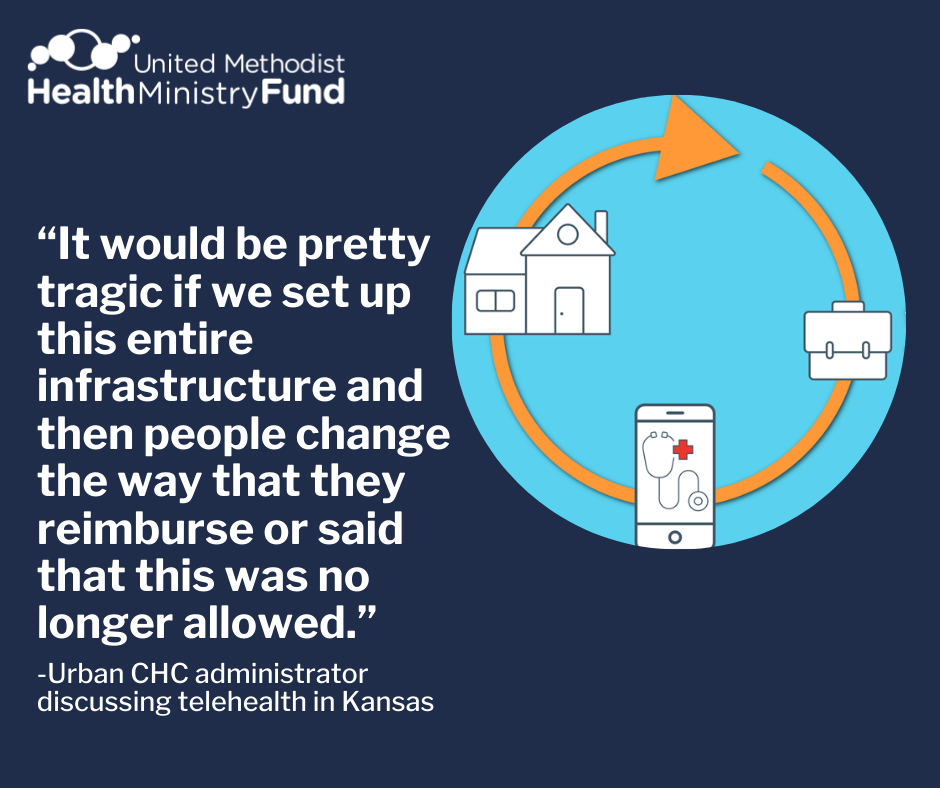
Providers say telehealth will remain an important part of ensuring patients can access care. In fact, many outpatient providers are planning to expand telehealth services. Respondents reported that policy changes negatively impacting telehealth reimbursement would be a barrier to greater use of telehealth and thus access to needed services and specialists. The following illustrative quotations demonstrate providers’ sentiments overall about the use of telehealth:

“I was totally against telehealth before COVID. I did not see a use for it in my practice. Now that I have tried it…my patients and I love it. I’m very afraid that reimbursement will be taken away and I will have to give it up.”

“We need to continue to be able to provide telehealth and phone services for our patients to keep them safe and be reimbursed like in person visits so that keeping our patients safe does not negatively impact our ability to keep our clinic doors open. The overhead cost of providing telehealth services makes this difficult otherwise.”

85 percent of providers responding to the survey said expanded reimbursement was the #1 priority for making sure telehealth continues to have a positive impact in Kansas.

Previous research and this survey highlight that telehealth offers many benefits to Kansans, such as:

  • Improving access to care for patients in both urban and rural settings
  • Increasing continuity of care
  • Decreasing time away from work or families to see medical providers
  • Allowing providers to better contain and manage health care costs

Telehealth is not intended to replace in-person care, but provides both patients and health care providers with options that can contribute to positive patient outcomes, including, for example, chronic disease management and monitoring in elderly or vulnerable patients who are at risk for falls and where in-home monitoring presents a safer option.

This initial survey is strong evidence that telehealth can play a significant role in improving health care access for Kansans. More information can be found in the full report here: healthfund.org/a/telehealth-report-20.

Thriving Congregations

Health Fund receives five-year Lilly Endowment grant to strengthen partnerships and expand programs supporting community health ministry

At the United Methodist Health Ministry Fund we work hard each day to improve the health of Kansans through strategic philanthropy guided by Christian values, which is why we’re excited to announce that we received a five-year Thriving Congregations Initiative 2020 grant from the Lilly Endowment.  The $999,058 grant will enable the Health Fund to strengthen our partnership with the Neighboring Movement to expand both the Healthy Congregations program and the Good Neighbor Experiment.

Health Fund President David Jordan highlights the impact of the Lilly Endowment’s Thriving Congregations grant

Our Healthy Congregations program recognizes that local churches play a major role in shaping each community’s culture, values, and sense of place. Healthy Congregations engages Great Plains United Methodist churches in projects to improve spiritual, physical, social, and emotional health in their congregations and communities.  As part of our Healthy Congregations program we work to build leadership among participating congregations by providing training, resources, and financial support to Great Plains United Methodist churches committed to health ministry.

We also offer special grant initiatives to support congregations interested in addressing social needs.  As a strategy to help increase a congregation’s capacity to address social isolation and other needs in their community, one of the special grant opportunities we’ve been supporting is the Neighboring Movement’s Good Neighbor Experiment.  The Good Neighbor Experiment leads cohorts of participating congregations through three training workshops using a 24-week curriculum that connects asset-based community development with time-honored Christian values, focusing on strengths versus needs and helping teams practice the learned skills of community neighboring.  Through our partnership, 18 Great Plains United Methodist Conference congregations are currently participating in the program.

Looking forward, we are excited about the Lilly Endowment’s Thriving Congregation Initiative grant because it will enable us to partner with the Neighboring Movement to bring the Good Neighbor Experiment to many more churches within the Great Plains Conference and to churches throughout the country.  The grant will also help us expand our Healthy Congregation program and the capacity of leaders within Healthy Congregations churches to grow their health ministry and improve health in their community.   As we look to the future, we know that building on the strengths within congregations can help us improve health and address challenges resulting from health crises like the pandemic or the increasing prevalence of social isolation and division.  We’re excited to take on these challenges in partnership with the Neighboring Movement and with support from the Lilly Endowment.

A news release for this announcement is available here.

United Methodist Health Ministry Fund’s Commitment to Racial and Health Equity

For over thirty years the United Methodist Health Ministry Fund has worked to improve the health and wholeness of Kansas through bringing together people from communities throughout Kansas and more recently, Nebraska. We value partnerships and collaboration and speaking out for the greater good, which is why it’s critical to state that that we do not stand for racism, intolerance, or violence of any kind. We stand for and support our Black, Indigenous, and People of Color (BIPOC) friends and neighbors and believe that black lives matter.

The deaths of George Floyd, Breonna Taylor, Ahmaud Arbery and the previous deaths of many more Black Americans unjustly killed illustrate the systemic racism that is pervasive in our country. This structural racism is further underscored by the disproportionately large number of people of color suffering and dying from COVID-19. The United Methodist Health Ministry Fund shares the frustration that many feel and is committed to countering the structural and systemic racism that is deeply rooted in our state and our country.

At the Health Fund, we will work to address racial and health equity through support for policy and systems change as well as efforts to increase participation in our democratic process. We will advocate for policies that address long-standing inequities and support Black, Indigenous, and People of Color-led organizations that are working on these important issues. 

Kansas has one of the largest racial disparities of COVID-19 deaths in the country.  In Kansas, about six percent of the population is African American, but of COVID-19 deaths, African Americans account for 30 percent. That’s five times higher than their share of the state’s population. We will continue to work to better understand that stark disparity and to address it through advocacy, convening and funding.

At the Health Fund, we will faithfully work towards racial and health equity, holding ourselves accountable and encouraging others to do the same.  We stand ready to partner with groups to do just that in Kansas and beyond.

Healthy Congregations 2020 Improvements Webinar

Drawing on conversations with team leaders, surveys of all Healthy Congregations teams last fall, and extensive collaboration between staff and program partners, we’ve been hard at work on improving and streamlining the Healthy Congregations program – and we’re excited to introduce the 2020 program changes. This webinar outlines both the program benefits which will continue, and the new improvements to streamline participation. Delays in program dates due to COVID-19 and updates on special grant opportunities for Healthy Congregations teams are also covered. The webinar was presented live April 28, 2020. A recording and the presentation slides are available below.

You may download the webinar slides here.

The Healthy Congregations program provides training, resources, and financial support to Great Plains United Methodist churches committed to congregational and community health ministry.

Healthy Congregations & COVID-19

As we work to support the needs of our communities, we realize one of our great strengths is to be able to partner with nearly 100 active United Methodist Congregations that participate in our Healthy Congregations Program.  We are excited to work to provide financial and technical assistance to Healthy Congregations members as they respond to COVID-19 in their communities.

In these unprecedented times, our Healthy Congregations teams and their local partners are continuing to work to support families, friends, congregations and communities across the Great Plains Conference. We have heard from many of our teams and are impressed not only with their passion and commitment but also their creativity and resourcefulness in responding to rapidly developing community needs.

Our congregations play an important role in supporting our communities and responding to this crisis. Today, we are announcing a special grant opportunity for current Healthy Congregations teams in good standing to apply for up to $500 in additional funding to support ministry assisting with response to COVID-19. Focusing this opportunity on currently established teams allows us to quickly turn around submissions and keep the application form simple.

In terms of how teams might use the resources, we wanted to share a couple of examples of what we have heard from local teams. Several are working to increase support to local food banks and supporting programs such as the Summer Food Service Program, (another available opportunity for HC teams) to help prevent hunger during the crisis.  Other congregations are making face masks for health care providers in the community. A template for making masks is available here: https://www.cdc.gov/coronavirus/2019-ncov/prevent-getting-sick/diy-cloth-face-coverings.html

While these are just two ideas on how teams can focus their ministry to respond to COVID-19, we hope these resources can provide the flexibility to best help congregations respond to community needs during this time.

Beyond important ministry work, we can also all benefit our communities by being good and supportive neighbors. We asked our friends at the Neighboring Movement to share their thoughts on ways to be a good neighbor in this time of social distancing – available above or via https://youtu.be/rOtySmBzJrc.

Together, we will get through this time.  We look forward to further partnering with our Healthy Congregations teams to support congregation-led work to address community COVID-19 needs. Please apply in the coming weeks and be in touch with questions to Katie katie@healthfund.org. Thank you for your leadership and ministry during these challenging times. 

We’re Counting on You!

Happy Census Day! While we are focused on keeping our families, friends, and communities safe during the COVID-19 crisis, I wanted to take the time to highlight how important it is to fulfill our constitutional obligation to complete the 2020 Census.

The Census is a once-a-decade population and housing count of all 50 states, the District of Columbia, Puerto Rico, and the Island Areas. The results of the Census determine the number of seats for each state in the U.S. House of Representatives and are used to draw state legislative and local district boundaries. Federal agencies use census data to distribute more than $6 billion in federal funds to Kansas each year.

Kansas communities depend on these funds to sustain everyday services, which is why it is critical for the future of our own communities and the state that everyone is counted as part of the 2020 Census. Every uncounted person costs the state of Kansas approximately $2,082 in federal funding annually – meaning if you’re not counted, we will be shortchanged for a decade and our communities and services will suffer.

Hard-to-count populations like rural communities, children and seniors are at high risk of being undercounted. Having a large portion of Kansans go without being counted in the Census would have a devastating impact on our state and these populations.

On Census Day, please take the time to complete the Census – it’s quick and easy. In the last three weeks, you should have received mail from the Census that includes a code and web link. Using the code, you can complete the Census in minutes. It’s so simple, we ask that you also take the time to let your friends, family, and neighbors know how important – and easy – it is to complete the Census. Please, use the tools and videos we’ve created on the Census or visit KansasCounts.org to access great content to share with your networks.

We’re counting on you!

David Jordan,

President & CEO, United Methodist Health Ministry Fund

Healthy Congregations Retreat Cancelled

April 16 update: Healthy Congregations COVID-19 Response Grants available

Health Fund staff and directors have been closely monitoring the rapidly developing situation with the spread of novel coronavirus and increasing incidence of COVID-19.  With protecting the health of our participants foremost in mind, we have made the difficult decision to cancel the 2020 Healthy Congregations Retreat (previously scheduled for April 23-25).

Our Board of Directors has authorized re-purposing of funds which would have supported the retreat to instead support COVID-19 response grants to current Healthy Congregations churches. Information on how to apply is available here.

We are sensitive to the impact cancellation of the April dates may have on teams seeking certification training for Healthy Congregations program grant renewal, and on those planning to participate in the special opportunities such as Good Neighbor Experiment and Strengthening Families Program training.  We are currently exploring alternative options for these programs and will update as information becomes available.

For participants who had already registered for the 2020 retreat, we have reached out directly, and your registration deposits have been returned/refunded.  If you have questions, please contact us at healthfund@healthfund.org. 

HC Webinar: Census 2020

Our February 11, 2020 Healthy Congregations Learning Community webinar features Blanca Soto, Southwest Kansas Campaign Director, covering Why the Census Matters: Ensuring Everyone is Counted. The webinar also highlights special HC grant opportunities and program updates.

The recording is available below. Presentation slides: 2-11-2020 Webinar.

2-12-2020 Healthy Congregations Learning Community Webinar – Census 2020
Kansas Counts Census 2020

Every 10 years, the Census Bureau takes a count of all people living in the United States, but many Kansas communities and populations are at risk of being undercounted. The census affects business planning, community development, funding for essential community programs (an estimated $4.5 billion in federal funding for Kansas) and our representation in Congress. Faith leaders are our trusted voices in the community. You know how to reach your congregation and members; hard-to-count families, individuals and children. If your team is interested in ensuring everyone is counted this webinar outlines practical ways your congregation can get involved! Learn more at KansasCounts.org.

August Proclaimed Breastfeeding Awareness Month

Press Release from KDHE, August 2, 2019

Governor Kelly Proclaims August “Breastfeeding Awareness Month”

TOPEKA – At an official signing ceremony, Governor Laura Kelly proclaimed August “Breastfeeding Awareness Month” in Kansas. This proclamation recognizes the importance of breastfeeding for the health and wellbeing of Kansans.

“We are extremely pleased with Governor Kelly’s proclamation which highlights the importance of breastfeeding support for families in Kansas. This proclamation supports their decision and provides a foundation to build support for the policy and practice changes needed to build a landscape of breastfeeding support in our state,” said Brenda Bandy, Executive Director of the Kansas Breastfeeding Coalition (KBC).

“Kansas recognizes breastfeeding as a public health responsibility and priority,” said KDHE Secretary Lee Norman, MD. “Strides in improved breastfeeding rates have been possible through strong statewide partnerships and community collaboration. We will continue to promote and support breastfeeding as a way to protect and improve the health of mothers and infants.”

More than 90 percent of families in Kansas choose to breastfeed. Yet despite its importance, only 31 percent of Kansas’ infants are exclusively breastfed during the critical first six months of life. Increased investment in breastfeeding could result in saving an estimated 22 women’s lives each year due to breast cancer, heart disease, diabetes and hypertension. Investing in breastfeeding could save the lives of seven children annually, due mostly to Sudden Infant Death Syndrome (SIDS) prevention. And finally, investing in breastfeeding would save Kansas more than $27 million in medical costs each year1.

Today’s proclamation stresses the role of every Kansan to make breastfeeding easier in our state. The Kansas Breastfeeding Coalition has suggested actions various groups and individuals can take to support breastfeeding in “The State of Breastfeeding in Kansas.”

1 Breastfeeding Saves Lives Calculator Access July 2019. Stuebe, A. M. et al (in press – 2017). An online calculator to estimate the impact of changes in breastfeeding rates on population health and costs. Breastfeeding Medicine.

2019 Healthy Congregations Retreat

The 18th annual Healthy Congregations Retreat, with a theme of Building a Healthier Tomorrow Together, brought nearly 110 participants to Rock Springs in late April to explore new ways Great Plains United Methodist churches can facilitate congregation-led community projects aimed at improving health – both directly and by addressing key underlying factors. Dr. Kate Kingery Deputy Director, Community Transformation, County Health Rankings and Roadmaps, kicked off the event with a keynote titled Health is More Than What Happens in Your Doctor’s Office illustrating how factors in the places we live, learn, work, and pray have a strong influence on health. See the below video for highlights of the 2019 event.

© United Methodist Health Ministry Fund