Author: Lindsey Fields

The state of breastfeeding in Kansas

This guest blog post was authored by Brenda Bandy, IBCLC, and Jennie Toland, BSN, RN, CLC, Co-Executive Directors of the Kansas Breastfeeding Coalition.

“[…] exclusive breastfeeding goes a long way toward canceling out the health difference between being born into poverty and being born into affluence…It is almost as if breastfeeding takes the infant out of poverty for those first few months in order to give the child a fairer start in life […]”

James P. Grant, former UNICEF executive director

We are thrilled to report the state of breastfeeding in Kansas is strong! According to data from the Centers for Disease Control and Prevention (CDC) released on August 1, Kansas exceeds the national rates of breastfeeding in all measures. Kansas ranks 14th in the nation in the percent of infants exclusively breastfeeding at 6 months of age for babies born in 2019. This is up from 27th place only five years ago.
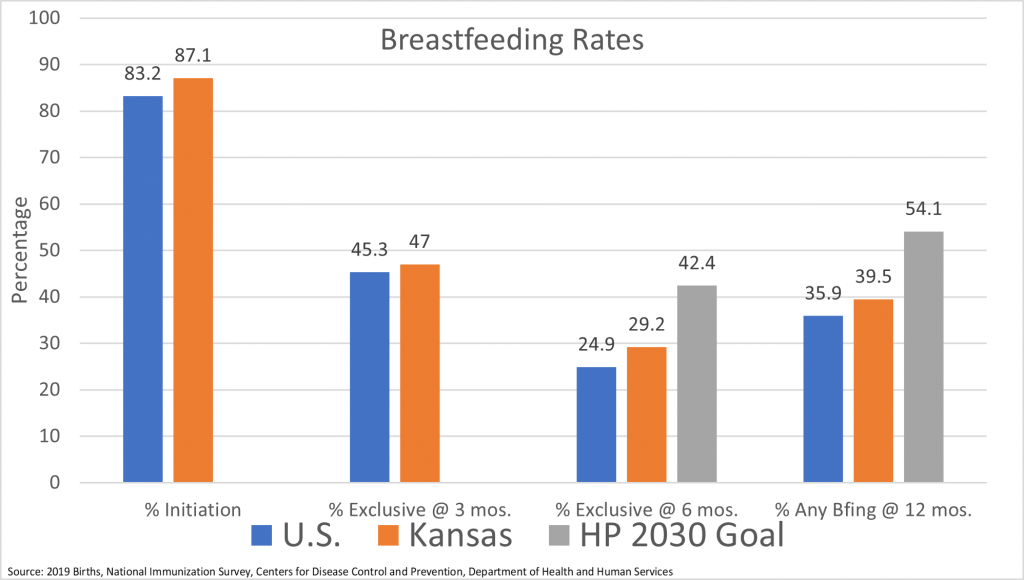
The data show nearly 90% of families in Kansas choose to breastfeed. However, the choice to breastfeed is negatively influenced by lack of support in the workplace, lack of access to clinical and peer lactation support, and often lack of family support. Without the right support, the choice to breastfeed isn’t a choice at all.

Consider this map above of breastfeeding initiation rates by county. The counties in pink exceed the state average in breastfeeding initiation rates. The counties in white have the lowest rates of breastfeeding initiation. Social determinants of health can greatly impact breastfeeding rates. We must carefully consider what factors are making it difficult for families to be able to choose to breastfeed.
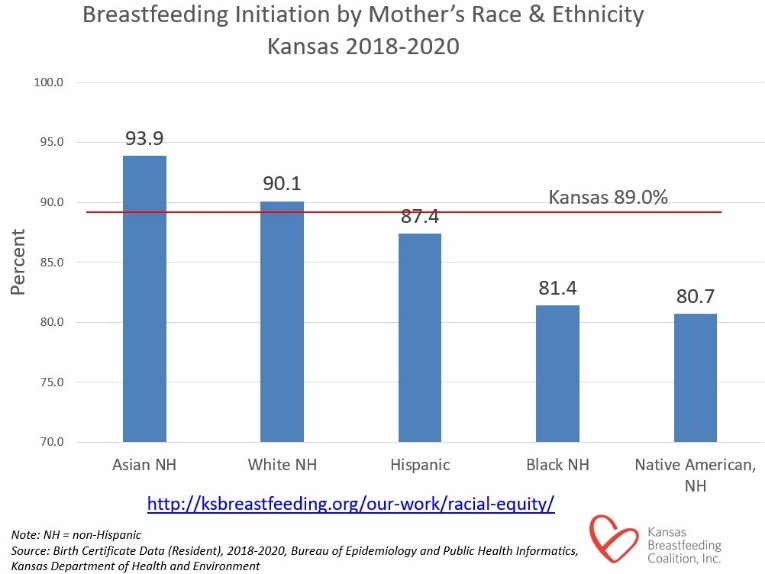
The graph above illustrates the gaps in breastfeeding rates. These disparities result from structural barriers and historical trauma that make it more difficult for Black, Indigenous and Latina mothers to engage in a traditional practice that has sustained their cultures over generations. While Black and Indigenous families do breastfeed, they do so despite bias and inequities.

The KBC has taken the following action to address racial disparities in breastfeeding rates with support from our partners at the Kansas Department of Health and Environment (KDHE) and the United Methodist Health Ministry Fund (Health Fund):

How can we make impactful and sustainable improvements to breastfeeding?  The answer lies within the community. It is our responsibility to support communities and ensure they have needed resources. While we celebrate increased breastfeeding rates in Kansas, a “rising tide” of breastfeeding support is not enough when some families in Kansas are not even in a boat.

The American Academy of Pediatrics’ (AAP) new Position Statement: Breastfeeding and the Use of Human Milk highlights the importance of supportive policies and systems. The AAP statement recommends “Policies that protect breastfeeding, including universal paid maternity leave, the right of a woman to breastfeed in public, insurance coverage for lactation support and breast pumps, on-site child care; universal workplace break time with a clean, private location for expressing milk, the right to feed expressed milk, and the right to breastfeed in child care centers and lactation rooms in schools are all essential to supporting families in sustaining breastfeeding.”

The KBC and our partners, including the Health Fund and KDHE, are working on improving policies, systems and environments to be more supportive of breastfeeding families.

A recent policy “win” for families in Kansas was the extension of Medicaid postpartum coverage for mothers from a mere 60 days to a full year. This extension of access to coverage will increase access to breastfeeding support in addition to essential physical and mental health services during the first year after giving birth.

Many hospitals across Kansas have contributed to the rising breastfeeding rates in Kansas. Thanks to the Health Fund’s investment in High 5 for Mom & Baby, Kansas ranks 13th in the nation for maternity care practices as measured by the CDC Maternity Practices in Infant Nutrition and Care survey.

If you are curious what breastfeeding support looks like in your county, visit the KBC’s Breastfeeding Support by Kansas County. This document allows you to easily see not only breastfeeding rates but also peer, clinical, and systems-level support for breastfeeding.

We invite you to join the Kansas Breastfeeding Coalition to build on this momentum and continue to improve policies, systems and environments to support Kansas families to breastfeed.

Please consider taking the following actions to support breastfeeding in your community.

ACTION IDEAS

INDIVIDUALS CAN:

HEALTHCARE PROVIDERS CAN:

BUSINESSES CAN:

HOSPITALS CAN:

STATE AND LOCAL GOVERNMENT CAN:

  • Help hospitals connect parents to community breastfeeding resources once they leave the hospital.
  • Support and participate in local breastfeeding coalitions.
  • Support paid family leave.
  • Support KanCare coverage of lactation and doula services.

About the series

This is the second post in a series on breastfeeding in Kansas. The full blog series includes:
Disrupting the school-to-prison pipeline will reduce disparities for Kansans

This commentary originally ran in the Kansas Reflector on August 4, 2022. About the authors: Dr. Tiffany Anderson, superintendent of Topeka USD 501, and Dr. Shannon Portillo, associate dean and professor at the University of Kansas, served as co-chairs of the Governor’s Commission on Racial Equity and Justice; David Jordan, president and CEO of the United Methodist Health Ministry Fund, chaired the subcommittee on health care.

All kids should have the same opportunity to thrive.

The school-to-prison pipeline begins as early as preschool, when students are pushed out of school through out-of-school suspensions and expulsions. The overly harsh, disproportionate discipline for students in poverty and students of color often continues throughout PreK-12 and can force children into the prison system.

According to the National Conference of State Legislatures, the school-to-prison pipeline “framework identifies ‘zero tolerance’ discipline policies, the involvement of law enforcement in school discipline and implicit bias as factors driving the disproportionate incarceration of young people of color.”

In Kansas, the school-to-prison pipeline disproportionately affects children of color. The Governor’s Commission on Racial Equity and Justice examined the pipeline with a focus on the juvenile justice and education systems. The commission’s final report made recommendations in the areas of early childhood development, behavioral health, juvenile justice, and school resource officers.

Implicit bias plays a role in creating the school-to-prison pipeline. Educators may be unaware of their biases, and they may unconsciously reflect those biases on particular student groups but not others. To address these issues, it is critical for educators beginning in the preschool setting through K-12 to receive implicit bias training.

Many children are not screened for developmental delays and disorders, mental health issues, and disabilities. When children with disabilities, sensory overload, mental health issues or trauma misbehave, we need to consider if we’re treating the behavior or punishing them. To provide treatment, a diagnosis is needed. It’s critical to increase funding for early childhood and developmental screenings.

Our nation is undergoing a pediatric mental health crisis. Rates of depression and anxiety among kids 3 to 17 have increased over the past five years — they were already trending upward before the pandemic. In 2020, nearly 1 in 10 kids (9.2%) had been diagnosed with anxiety issues.

Adverse childhood experiences (ACEs), such as abuse, neglect or other environmental factors that lead to instability, are linked to mental health and substance use issues in adolescence and adulthood.

Rather than punishment, which can have lifelong consequences, children should receive behavioral health services in educational settings as early interventions.

According to a Yale University study, preschool students are expelled more than three times as often as K-12 students. Expulsion rates were lower in settings where the preschool teachers had access to classroom-based behavioral health consultants. The commission recommends increasing availability of infant/early childhood mental health consultation services in the state to ensure children receive age-appropriate behavioral health support.

To reduce interactions with the juvenile justice system, we must examine and improve school disciplinary policies.

Some school districts employ school resource officers. If law enforcement is used in a school for any reason, the school district and law enforcement agency should have a memorandum of understanding in place. Officers’ roles should consist of mentoring students and enforcing laws, not disciplining students or enforcing school rules. Officers need to receive ongoing education and training in implicit bias and school-based strategies to support students’ social and emotional health.

Zero tolerance policies should be eliminated. Instead of subjective language — such as “disrespect” or “disobedience” — discipline policies should provide clear examples of behaviors that will not be tolerated.

Kids who are suspended or expelled from school are more likely to interact with the justice system. In 2013-2014, Black preschool students in Kansas were 5.6 times more likely than their white peers to receive out-of-school suspension and the trend continued throughout K-12 education.

Suspending kids from school doesn’t improve their academic achievement or do much to reduce their misbehavior. Schools should practice alternatives, such as alternative schools, behavior intervention and family case managers.

In the Kansas juvenile justice system, disparities are most prevalent at the arrest level — although total arrests have decreased, disparities have climbed. According to a 2019 report by Kansans United for Youth Justice, “as the national disparity rate for black youth dropped 21% between 2006 and 2013, the disparity rate in Kansas for black youth rose 51% during the same period.”

Incarceration and out-of-home placement should be last resorts.

We should support proven programs that improve outcomes and reduce recidivism rates for young people in the juvenile justice system, focusing on behavioral health, career skills and housing supports.

To track Kansas’ efforts to address disparities and to understand where investments are most needed, the state should disaggregate juvenile detention data by race and ethnicity as well as location.

We must disrupt the school-to-prison pipeline and support youth who are currently affected. Let your school board members and legislators know that these issues matter and encourage them to act.

About this series

In June 2020, Gov. Laura Kelly signed Executive Order 20-48, forming the Governor’s Commission on Racial Equity and Justice. The Commission studied issues of racial equity and justice across systems in Kansas, focusing first on policing and law enforcement and then on economic systems, education, and health care. The Commission developed recommendations for state agencies, the Legislature, and local governments. Through the end of 2022, commissioners will dig deeper into the recommendations in a monthly series.

Related resources

Governor’s Commission on Racial Equity and Justice reports
Governor’s Commission on Racial Equity and Justice webinar series
2022 opinion series on commission recommendations

Kansas’ breastfeeding journey: reflections and the road ahead

By Katie Schoenhoff, Director of Programs

Happy National Breastfeeding Month.

As we celebrate National Breastfeeding Month, we are reminded of the gains achieved and the work ahead in helping ensure that breastfeeding’s numerous health benefits are available to all mothers and children.

At the United Methodist Health Ministry Fund, we have worked to support breastfeeding for more than 15 years. In early years, we supported breastfeeding as a proven way to help prevent early childhood obesity. Since 2010, breastfeeding support has been a cornerstone of our strategic work, and the more we’ve gained understanding about the physical, emotional, and relational benefits that breastfeeding has for both a child’s and mother’s well-being, the more importance we’ve placed on this work.

A 2007 breastfeeding support grant to United Methodist Mexican-American Ministries (now Genesis Family Health) in western Kansas was a success in its own right, but also highlighted several challenges and opportunities that have guided our subsequent work.

One early learning was that mothers often face challenges which make it difficult to continue breastfeeding when returning to work. In 2010, we began supporting the Kansas Breastfeeding Coalition’s Business Case for Breastfeeding program, which illustrates the bottom-line benefits of supporting breastfeeding employees and simple, low-cost ways to do so.

We learned that supportive maternity facility policies and procedures, trained health care providers, and post-delivery/postpartum access to lactation support make a huge difference in initiating and maintaining successful breastfeeding. We also learned the importance and value of collaboration across the national, state, and local levels.

The Health Fund worked with the Kansas Breastfeeding Workgroup to develop the High 5 for Mom and Baby program that started in 2011. This program provides training, resources, and a framework to help Kansas hospitals and birth facilities implement five or more evidence-based practices proven to support successful breastfeeding, improving maternal and infant health outcomes while also reducing racial and ethnic health disparities.

To obtain High 5 for Mom & Baby recognition, facilities complete a voluntary, self-reported evaluation and follow five or more of the evidence-based High 5 for Mom & Baby practices.

In 2014, we co-sponsored the Kansas Health Summit on Breastfeeding with the Kansas Health Foundation (KHF). From there, we and KHF used the summit to inform a grant initiative where we co-funded 10 projects to work on physician education, lactation support services, regional coalition development, and more.

We’ve continued to work in partnership with the Kansas Breastfeeding Coalition and have long funded the organization’s leadership as well as various projects providing a continuum of care for women prenatally and throughout their breastfeeding journey.

Gaining experience through these projects, we have continued to adapt and modify our breastfeeding work as we saw more Kansas hospitals taking on maternity care best practices each year. Starting in 2016, we provided funding for five hospitals to work toward the rigorous Baby-Friendly designation, which all five have now achieved. We then partnered with Kansas Department of Health and Environment (KDHE) to co-fund another five hospitals. At this time, 10 Kansas hospitals maintain the Baby-Friendly designation, covering nearly 50% of births in our state.

While Baby-Friendly designation is the “gold standard” for supporting breastfeeding in maternity care settings, we recognized that many other hospitals are working to improve their goals and may not have the staffing or financial means to achieve the designation.

In 2020, we launched the High 5 for Mom and Baby Premier program. These facilities follow all 10 of the evidence-based High 5 for Mom & Baby practices. This spring we announced that 22 facilities had achieved premier recognition, which is the largest number of hospitals to earn the premier recognition since it was introduced.

Since we’ve entered the breastfeeding field, we have seen significant increases in breastfeeding initiation and duration rates for the state. In 2021, Kansas reached the top 15 states for all measures for the first time.

This is in part because multiple funding partners have worked together to support the field, including KDHE and KHF. So much traction has been gained and we have valuable leadership from the Kansas Breastfeeding Coalition and local coalitions across the state that have helped Kansas see significant gains in lactation support and policies within hospitals and communities. This work has led to more women receiving supports in various settings—local businesses, workplaces, places of worship, health departments, and more. All of us working together has made a significant difference for women and children across our state.

While there is much to celebrate, there is much left to do. Although the overall breastfeeding rates are improving, rates for Black and brown women–as was the case in 2007 and unfortunately remains true today–are not seeing as many improvements and these gaps need to be narrowed. In recent years, our work with the Kansas Breastfeeding Coalition has focused on working with coalitions led by women of color to support their communities. We continue to proudly support the work that the coalition is doing to amplify all voices.

During National Breastfeeding Month we should celebrate the work that has been accomplished, but we still must all come together and continue to help every Kansas family achieve their infant feeding goals to create the best outcomes for mothers and babies.  

About the series

This is the first in a multipart series on the state of breastfeeding in Kansas. Next week we’ll learn more from the Kansas Breastfeeding Coalition on how our state ranks in breastfeeding and how individuals and businesses can support breastfeeding mothers.

The full blog series includes:
High 5 for Mom & Baby Practices

The ten High 5 for Mom & Baby practices are based on the WHO/UNICEF Ten Steps to Successful Breastfeeding – evidence-based practices proven to increase breastfeeding success and reduce racial and ethnic disparities.

1. Facility will have a written maternity care and infant feeding policy that addresses all ten High 5 for Mom & Baby practices supporting breastfeeding 

2. Facility will maintain staff competency in lactation support

3. All pregnant women will receive information and instruction on breastfeeding

4. Assure immediate and sustained skin-to-skin contact between mother and baby after birth

5. All families will receive individualized infant feeding counseling

6. Give newborn infants no food or drink other than breastmilk unless medically indicated

7. Practice “rooming in” – allow mothers and infants to remain together 24 hours a day

8. Families will be encouraged to feed their babies when the baby exhibits feeding cues, regardless of feeding methods

9. Give no pacifiers or artificial nipples to breastfeeding infants

10. Provide mothers options for breastfeeding support in the community (such as a telephone number, walk-in clinic information, support groups, etc.) upon discharge 

Using Proven Early Childhood Interventions to Combat ACEs

This piece originally appeared in the Kansas Child summer 2022 issue. David Jordan is president and CEO of the United Methodist Health Ministry Fund.

It’s true what they say: children don’t come with an instruction manual. These days, many families are struggling to feel successful raising their children while also coping with the many demands and challenges of modern life.

Toxic stress and adverse childhood experiences (ACEs) are major influences on a child’s overall development — affecting school readiness, student success, physical and mental health, and other factors, including the ability to exercise self-control. ACEs include abuse, neglect, witnessing violence, mental health or substance use problems in the household, and instability in the household, such as separated parents, among other experiences.

ACEs are incredibly common. According to the CDC, approximately 61% of adults surveyed across 25 states reported that they had experienced at least one ACE, while 1 in 6 had experienced at least four. In Kansas, 39% of children have experienced an ACE, and 20% have experienced two or more ACEs.

The first step toward addressing toxic stress and supporting children’s physical health and social-emotional development is to screen early and regularly. Performing a developmental screening when a child first enrolls in early care and education can identify potential risk factors or barriers to success. In many cases, when these concerns are identified and addressed early, the interventions are less intrusive, and children reach developmental milestones more quickly.

Programs and Interventions

Caring and responsive relationships are critical for every child’s healthy development. A number of programs and interventions, including evidence-based home visiting models within the state, nurture caring relationships and positive childhood experiences.

For example, evidence-based early literacy programs promote stronger caregiver-child relationships. Programs like Reach Out and Read (ROR) engage parents, children, and health care providers. ROR’s Perry Klass notes that by reading to young children, parents and educators are teaching responsiveness and cultivating routines and structures that will help children feel safe. These relationships and routines will stimulate healthy brain development and foster a love of reading, leading to improved language skills and health outcomes.

For kids with significant needs, caring and responsive relationships mitigate the effects of toxic stress. Research shows that infants and toddlers who have experienced adversity can benefit from early intervention that focuses on building supportive adult relationships.

One strategy to counteract early adversity is the evidence-based Attachment and Biobehavioral Catch-up (ABC) program. Over the course of the 10-week program, parents increase their knowledge and skills in order to create secure attachments and help their children have better outcomes. While babies cannot verbalize their needs, parents can learn to recognize and respond to their child’s cues, which leads to strong and healthy relationships.

Through support for evidence‐based early childhood development programs, we can ensure that the youngest Kansans enjoy nurturing family environments that prepare them for healthy lives and academic success. Investing in proven early childhood interventions as a state will result in a more capable workforce, reduced health care and mortality costs, and reduced demand for public services. Kansas’ future depends on the children we invest in today.

Child Care Providers & Infant Mental Health

No one can say that caring for infants is simple work. Understanding infants and toddlers and making sure they receive appropriate behavioral health support is difficult.

According to the American Academy of Pediatrics, as many as 1 in 10 preschoolers are affected by emotional, relationship, and behavioral problems. A young child’s misbehavior may be due to mental health concerns. Ensuring that children receive age-appropriate support as early as possible is important for their future health and school readiness.

How can child care providers promote good mental health?

• Connect parents to local resources, such as early childhood development centers that specialize in home visiting and building parents’ caregiving confidence and skills.
• Provide age-appropriate screenings for children in your care. If you are not currently using screenings, you can attend ASQ trainings through the Kansas Technical Assistance System Network (TASN).
• Advocate for statewide policy changes that would benefit infant mental health, such as increased consultation services and the use of the DC: 0-5 diagnostic classification tool.

God’s Temple: Health and Holiness in the Body of Christ

Our health is strongly influenced by a combination of biological, social, and environmental factors beyond our control: the conditions in our communities, the schools in our neighborhoods, the availability of healthy food and good jobs, and how close we are to hospitals and clinics.

As we continue to explore what it means to be healthy, the United Methodist Health Ministry Fund has created a sermon guide that will go beyond the physicality of what health “looks” like and deeper into holistic wellness that includes our emotional, physical, social, and spiritual health.

By exploring health from these four perspectives, the “God’s Temple: Health and Holiness in the Body of Christ” sermon guide opens a wider conversation about health and wellness that integrates with the church’s call to live as the Body of Christ in the world.

To help guide this conversation, the sermon guide utilizes select passages from Paul’s First Letter to the Corinthians.

Week 1 explores emotional health in relation to Paul’s teaching that the Christian community is the temple of God, highlighting belonging as crucial to our emotional well-being as humans.

Week 2 addresses physical health as an individual and communal endeavor as Christians are called to use our bodies to glorify God.

Week 3 explores social health using Paul’s discussion of whether the Corinthian Christians should eat meat sacrificed to idols. Paul’s teaching emphasizes that social health means loving God and loving neighbor by glorifying God while also actively seeking not to be a stumbling block to our neighbors.

Week 4 concludes the series by exploring spiritual health as the cultivation of love as the church cooperates in using our gifts to grow and act as the Body of Christ in the world.

We’d love to hear from you! Did you use the sermon guide and/or toolkit? Would you be willing to share your feedback and experiences? Questions or suggestions? Please email us at hcnews@healthfund.org.

Week 2

Week 3

Week 4

Social Media

Below are social media tiles to help you promote the series. We would love to know if you use the guide—please tag us on Twitter or Facebook (@umhealthfund).

Facebook

Twitter

Right now is the right time to vaccinate your child against COVID-19

This opinion piece originally appeared in the Topeka Capital-Journal on July 1, 2022. Gretchen Homan, M.D., is president of the Kansas Chapter of the American Academy of Pediatrics and former chair of the Immunize Kansas Coalition. David Jordan is president and CEO of the United Methodist Health Ministry Fund in Hutchinson. Pictured above is Elise, a Hutchinson teen who has long COVID.

With August around the corner, now’s the time to make sure our kids are protected from COVID-19 when they return to school. As parents, we want the best for our kids. It’s our responsibility to make decisions on their behalf to keep them healthy, safe and in a position to thrive.

We never expected parenting would involve a global pandemic, school closures, remote learning and protecting children who were not eligible for vaccines.

Thankfully, in recent weeks the U.S. Food and Drug Administration made it easier for all parents to protect their children from COVID-19 by authorizing vaccines for children ages 6 months through 4 years and boosters for children ages 5 through 11.

Thanks to established vaccine science, research, rigorous clinical trials, and ongoing safety monitoring, adults have been eligible to receive COVID-19 vaccines since December 2020. The results have been amazing — reduced risk of death, severe illness, hospitalization, and spread.

Adults helped us return to “normal,” but kids can keep us there. Children share viruses as easily as they share toys. Kids need protection from COVID-19, just as we protect them from other vaccine-preventable infections.

Following the same process, safe, effective vaccines and boosters have been available for children ages 5 to 17. Over 27 million children ages 5 through 17 have gotten a COVID vaccine.

The vaccines are safe and tested

Early on, we yearned for a return to “normal” and knew a vaccine was critical to achieving that goal. Thanks to established vaccine science, research, rigorous clinical trials, and ongoing safety monitoring, adults have been eligible to receive COVID-19 vaccines since December 2020.

The same rigorous authorization process was used for the vaccines for children under 5.

Children can get very sick from COVID-19

Much of what pediatricians do is preventive health care. Vaccines are a crucial part of that. Administered in a moment, vaccines can provide children with lasting protection from devastating illnesses.

To greatly reduce risks to our children, we must prioritize COVID-19 vaccination. However, in Kansas, only 25% of kids ages 5 through 11 and 53% of kids ages 12 through 17 have been fully vaccinated against COVID-19.

Since the beginning of the pandemic, children have accounted for about 19% of cases in the United States. Children are getting the virus.

Although the long-term effects of COVID-19 on the brain and organs are not entirely clear, we know some people, including children, suffer significant long-term complications that hinder their ability to live full lives. As parents, we should embrace the opportunity to vaccinate our children against COVID-19’s long-term effects.

Elise, a Hutchinson teen, was a healthy 15-year-old when she contracted COVID-19. After her quarantine ended, she returned to school. She didn’t make it through the day. She’d developed long COVID. She had no energy and was short of breath.

Seventeen months later, Elise is still attending school online. She can’t sit up for long periods of time without getting dizzy, and she uses a wheelchair to get around. Thankfully, she recently stopped using supplemental oxygen.

It’s normal to have questions about vaccinating your child. Doctors welcome them. If you have concerns about COVID-19 vaccines, please talk to your child’s doctor. We know appointments go quickly; a good way to prepare is to write your questions down beforehand and bring them with you.

As parents, we both chose to vaccinate our kids against COVID-19. We knew vaccination was critical to preventing illness, keeping them safe, and supporting healthy development.

Previous generations of parents were the first to vaccinate children against measles, rubella, and polio. When our children look back, they’ll realize how important it was for their parents to vaccinate them against COVID-19. Join us in doing everything we can to protect the health and well-being of our children.

You can find a COVID-19 vaccine near you at vaccines.gov or by calling (800) 232-0233.

Bridging the digital divide can reduce gaps between Kansas communities

This commentary originally ran in the Kansas Reflector on June 23, 2022. About the authors: Dr. Tiffany Anderson, superintendent of Topeka USD 501, and Dr. Shannon Portillo, associate dean and professor at the University of Kansas, served as co-chairs of the Governor’s Commission on Racial Equity and Justice; David Jordan, president and CEO of the United Methodist Health Ministry Fund, chaired the subcommittee on healthcare.

Dependable internet access is not an amenity — it’s essential for accessing services today, including health care, work and school. In Kansas, a digital divide separates the “haves” from the “have nots” in terms of devices, digital literacy, and access to high-speed internet. The COVID-19 pandemic highlighted digital gaps across our state, especially in internet access in rural and low-income communities and communities of color.

Digital equity is more than a quality-of-life issue; it plays a role in health care. A Federal Communications Commission task force is studying whether broadband connectivity should be considered a social determinant of health. Social determinants of health are the conditions where people live, work, and play that affect their health, such as transportation, neighborhood crime and education. Social determinants account for as much as 80% of a person’s health status. Digital equity may even be a “super” determinant because it affects other determinants — people search online for housing, transportation, and employment.

The Governor’s Commission on Racial Equity and Justice examined digital equity, seeking to understand how to address systemic issues that affect health outcomes, community vitality, and access to information and human services. Broadband recommendations to address racial equity were included in the commission’s final report. As we consider broadband policies and investments, we should treat broadband connectivity as a social determinant of health.

In 2020, the state established the Kansas Office of Broadband Development. This department focuses on connecting Kansans, with several investment programs focused on unserved and under-served areas. Multiple programs have been made possible through federal dollars. The commission recommended the state should maximize federal dollars to support broadband development and to increase access for hard-to-reach and vulnerable communities.

Kansas should support and invest in broadband access for all Kansans, but access is not enough. As state and local governments invest in broadband, they should also ensure their work is focused on digital equity.

To bridge the digital divide, Kansans need affordable broadband and appropriate devices, outreach to learn about available programs and digital literacy skills built with the help of culturally competent navigators.

Funds should be used to support digital navigators who help Kansans use online services and set up devices and home internet. The National Digital Inclusion Alliance provides a digital navigator toolkit designed with libraries, health care and other social service agencies in mind.

A major shift during the pandemic has been the increase in accessing health care online.

Many Kansans travel to receive care, must take off work for appointments, or have caregiving duties that make it difficult to visit the doctor. During the pandemic, telehealth services were expanded. Kansans were able to see their providers and specialists remotely, and providers were reimbursed for telehealth visits similarly to in-person visits.

In a statewide voter poll conducted for the REACH Healthcare Foundation and the United Methodist Health Ministry Fund, most Kansans (86%) said they support expanding or maintaining telehealth options after the pandemic ends. The poll oversampled Black and Hispanic voters. The study found that when it comes to accessing care, 71% of Kansans of color would prefer to see a doctor or health care professional who comes from their community, speaks their language and looks like them. Telehealth can help bridge that gap.

In a related consumer focus group survey, some patients shared that telehealth allows them to receive care they otherwise would not be able to access, including patients in rural areas who live hours away from specialists. However, others found internet connectivity to be a barrier.

“What frustrated me was the internet connection. While I’m at my parents’ I can FaceTime my son in Saudi Arabia, but I can’t talk to a local doctor 30 miles away. … So that is very frustrating to me to be talking to someone on the other side of the world and I’m not able to contact my local doctor,” said one focus group participant.

Community health workers or other care coordinators can serve as culturally competent digital navigators, helping patients set up their internet and teaching them how to use their personal devices to access telehealth appointments.

Interviews and a survey of Kansas health care providers and administrators found that for telehealth to remain viable, future financial support is needed for system upkeep and visit reimbursement. As a health equity strategy, Kansas should expand telehealth access and codify the regulations that expanded telehealth services.

As a state, we must continue removing barriers to ensure we’re reducing the digital divide, so that more Kansans can access information, health and human services, civic engagement, and educational and employment opportunities.

About this series

In June 2020, Gov. Laura Kelly signed Executive Order 20-48, forming the Governor’s Commission on Racial Equity and Justice. The Commission studied issues of racial equity and justice across systems in Kansas, focusing first on policing and law enforcement and then on economic systems, education, and health care. The Commission developed recommendations for state agencies, the Legislature, and local governments. Through the end of 2022, commissioners will dig deeper into the recommendations in a monthly series.

Related resources

Governor’s Commission on Racial Equity and Justice reports
Governor’s Commission on Racial Equity and Justice webinar series
2022 opinion series on commission recommendations

Let the Little Children: The Body of Christ and Childhood Health and Well-Being

The Health Fund believes that investing in early childhood development leads to the best health outcomes and the greatest return on investment. Research has shown that well-designed early childhood interventions can provide the support necessary to foster healthy brain growth and buffer children from the effects of adverse childhood experiences. We have learned that with adequate safe, stable, nurturing relationships during the first five years of life, children are more likely to succeed in school, become productive workers, and contribute to society.

The well-being of children in our churches and communities is an issue of great significance for the health and flourishing of children, families, and neighborhoods across the country and around the world. In an effort to connect the science of early childhood development and proven public health interventions with the life and mission of the church, this guide offers a three-week worship series that highlights three of Jesus’ interactions with children during his ministry.

Week 1 establishes the foundation for how and why Jesus welcomes and embraces children as part of God’s kingdom and invites the church to live into Jesus’ example by recognizing our Christian responsibility to nurture the well-being of children in our community.

Week 2 uses Jesus’ healing of the spirit-possessed boy in Luke’s Gospel as a model for how the church can tend to the physical health of children in our communities, paying particular attention to insurance coverage, wellness vaccines, and food security.

Week 3 then turns to Jesus’ Community Discourse in the Gospel of Matthew to explore Christ’s call to childlikeness as an invitation to promote children’s mental health by removing stumbling blocks and providing the relationships and skill-building necessary for children to build resilience in the face of adversity.

We’d love to hear from you! Did you use the sermon guide and/or toolkit? Would you be willing to share your feedback and experiences? Questions or suggestions? Please email us at hcnews@healthfund.org.

Resources

Nationwide Resources

Kansas Resources

Resources in this sermon guide

Week 1

Week 2

Week 3

Social Media

Below are social media tiles to help you promote the series. We would love to know if you use the guide—please tag us on Twitter or Facebook (@umhealthfund).

Facebook

Twitter

Sermon Workshop: Connecting Faith and Health

The Health Fund hosted a free online sermon workshop: “Connecting Faith and Health: A Sermon-Planning Workshop for Preaching with Impact.”

The Health Fund is dedicated to improving the health and wholeness of Kansans. Over the past year, the Health Fund has worked in partnership with Lisa Hancock, PhD, to develop a series of sermon guides that bring together Scripture, theology, and health to help congregations connect their faith to health.

Each sermon guide contains multiple weeks; each week includes a call to worship, hymn selections, children’s sermon, call to action, and benediction, in addition to an exegesis and sermon notes section based on the week’s scripture passage.

Lisa Hancock led the workshop. Watch the workshop recording to learn more about each guide, and leave with up to 25 weeks of your liturgical sermon calendar planned.

Workshop Recording

Workshop slides
Workshop notes sheets
0:00:00 Welcome
0:25:14 Overview of the Liturgical Year
0:44:58 Journey Toward Mental Wellness (Advent or Ordinary Time)
1:09:59 Naming Trauma and Practicing Resilient Love (Lent)
1:35:41 Tending the Civic Soil (Ordinary Time)
1:59:03 God’s Temple: Health and Holiness in the Body of Christ (Ordinary Time)
2:20:13 Wrapped in God’s Embrace: Maternal Health, Flourishing, and Building Communities of Care (Ordinary Time)
2:43:16 Let the Little Children (Ordinary Time)
2:59:17 Questions and Feedback
3:13:57 Closing Prayer and Benediction

Strengthening behavioral health access will help Kansans and address disparities

This commentary originally ran in the Kansas Reflector on June 2, 2022. About the authors: Dr. Tiffany Anderson, superintendent of Topeka USD 501, and Dr. Shannon Portillo, associate dean and professor at the University of Kansas, served as co-chairs of the Governor’s Commission on Racial Equity and Justice; David Jordan, president and CEO of the United Methodist Health Ministry Fund, chaired the subcommittee on healthcare.

The Governor’s Commission on Racial Equity and Justice repeatedly heard from community members, stakeholders, and those working in criminal justice about unmet behavioral health needs and how the lack of access to behavioral health care — both mental health services and substance use treatment — results in law enforcement encounters.

People with behavioral health conditions are three to six times more likely to be represented in the criminal justice system.

Additionally, data show racial disparities in the impacts of behavioral health systems on communities of color. For example, drug use rates are similar across racial and ethnic groups, but Black and Brown communities experience greater problems associated with substance use, such as legal issues, justice system involvement, and social consequences.

The commission examined behavioral health, seeking to understand how to address systemic issues that affect health outcomes, community vitality, crisis response and health care access. Behavioral health recommendations to address racial equity were included in the commission’s final report.

Law enforcement officers end up acting as de facto behavioral health providers. Investments should be made to increase the use of behavioral health trainings for officers to better prepare them to safely de-escalate and resolve emergency mental health situations.

Collaboration between local governments, law enforcement agencies and behavioral health providers can strengthen how law enforcement responds to behavioral health incidents. One successful model is the co-responder program, in which mental health professionals work alongside law enforcement to respond to mental health calls. Virtual models also show promise. This model contributes to positive outcomes and promoting treatment over incarceration for individuals experiencing mental health crises.

To address systemic behavioral health issues, we must invest in early interventions. Behavioral health services should be lifelong and more accessible to all.

Mental health services should target pregnant and new mothers so they can benefit from earlier diagnosis and treatment. We need to screen for and treat prenatal and perinatal depression to improve maternal and child health outcomes.

Kansas should utilize the DC: 0-5 diagnostic manual, which classifies mental health and developmental disorders for children ages 0 to 5 to enhance mental health professionals’ ability to accurately diagnose and treat mental health disorders and facilitate Medicaid reimbursement for appropriate treatments.

Children should be insured so that they can access behavioral health services. Kansas has a growing number of uninsured children. Between 2016 and 2019, the uninsurance rate for kids increased from 4.9% to 5.8%. In 2019, children who were racial and ethnic minorities were 3.6 times more likely to be uninsured than non-Hispanic white children. Implementing continuous coverage for children 0-5 would reduce the number of children who churn off Medicaid for administrative reasons.

Additionally, Medicaid should reimburse for evidence-based interventions such as home-visiting and early literacy programs that build safe, secure, nurturing relationships that improve health, educational and economic opportunities.

We need to ensure children are getting behavioral health services in early learning settings rather than being disciplined, which can have lifelong consequences. According to a Yale University study, preschool students are expelled more than three times as often as K-12 students. Expulsion rates were lower in settings where the preschool teachers had access to classroom-based behavioral consultants. The commission recommends increasing the availability of infant/early childhood mental health consultation services in the state to ensure children receive age-appropriate behavioral health support.

It’s important to improve behavioral health care access across educational settings. Possible initiatives include coordinating with local governments to ensure school-based services are available to the broader community, expanding hours of school behavioral health clinics, ensuring schools become Medicaid providers so they can directly bill and offering services in multiple languages.

Patients of all ages will benefit if behavioral health services are better integrated into our existing health care system and if the state supports the use of technology, such as telehealth or app-based providers, to make behavioral health services accessible

The current Medicaid eligibility limits are too low. Kansas should expand Medicaid, which would increase access to health care services and reduce uncompensated care — lowering costs for everyone. Hospitals and behavioral health treatment centers should automatically help eligible patients enroll in Medicaid upon discharge, increasing Kansans’ access to behavioral health services after release from treatment.

All levels of government can improve data tracking and coordination between systems within behavioral health, such as the criminal justice system. This should include maintaining race and ethnicity data on behavioral health incidents involving parents and young children to inform necessary interventions.

All Kansans would benefit from improved behavioral health services and access. To make these recommendations reality, we must urge our local and state representatives to support these changes that will improve the health of Kansans and address long-standing disparities.

About this series

In June 2020, Gov. Laura Kelly signed Executive Order 20-48, forming the Governor’s Commission on Racial Equity and Justice. The Commission studied issues of racial equity and justice across systems in Kansas, focusing first on policing and law enforcement and then on economic systems, education, and health care. The Commission developed recommendations for state agencies, the Legislature, and local governments. Through the end of 2022, commissioners will dig deeper into the recommendations in a monthly series.

Related resources

Governor’s Commission on Racial Equity and Justice reports
Governor’s Commission on Racial Equity and Justice webinar series
2022 opinion series on commission recommendations

© United Methodist Health Ministry Fund